
Affordable Pressure Washing for Industrial Zones: What to Expect?
Quick Summary
Affordable pressure washing for industrial zones covers concrete yards, truck courts, parking lots, building exteriors, and drainage lines on a predictable budget. Costs depend on surface condition, oil buildup, site access, and cleaning frequency, so a written scope and site walk give the most accurate price.
- Bundling yards, parking, exteriors and curb lines into one visit can reduce setup and travel costs.
- Degraded surfaces and heavy oil or tire marks raise cost through extra passes and detergent dwell time.
- Monthly cleaning spreads mobilization across more visits, lowering the cost per visit.
- Request a written scope from two or three providers so quotes can be compared fairly.
- Ask for a plan showing how wash water is contained and recovered, and confirm your insurance certificate.
Table of Contents
- What Affordable Pressure Washing for Industrial Zones Actually Covers
- What Drives the Cost of Pressure Washing an Industrial Site
- Commercial Pressure Washing Cost: Typical Pricing Structures
- Choosing the Right Pressure: Why a Commercial Pressure Washer 4000 PSI Matters
- Hiring a Service Versus Buying Equipment: Industrial Pressure Washing Equipment Cost
- Water Tank Units and Site Access: Commercial Pressure Washer With Water Tank Options
- Scheduling, Compliance, and Vendor Questions to Ask Before You Book
- Requesting a Free Estimate for Your Industrial Site
- Frequently Asked Questions
What Affordable Pressure Washing for Industrial Zones Actually Covers
Last Updated: November 14, 2026
Industrial zones collect grime that ordinary exterior cleaning never touches: oil drips on loading docks, tire marks in truck yards, algae on concrete, and dust that settles on every surface. Affordable pressure washing for industrial zones means getting that level of cleaning done on a predictable budget, without paying for capacity or features the site will never use.
The scope usually covers four areas: concrete yards and truck courts, parking and staff lots, building exteriors and loading bays, and drainage or curb lines where debris builds up. Bundling these into one recurring visit can reduce cost compared with separate one-off jobs, because mobilization and setup are the expensive parts of any visit.
Affordability depends on how the work is scoped. A clear site walk, a defined cleaning area, and an agreed frequency let a contractor price the job accurately. Vague requests tend to produce either overpriced quotes or underperforming service.
What Drives the Cost of Pressure Washing an Industrial Site
Cost comes down to a few variables: total square footage, surface type, level of soil buildup, access restrictions, and how often the work recurs. Heavy oil staining takes more passes and sometimes degreasing agents, which adds time and materials. Concrete in good condition cleans faster than asphalt that has already begun to break down.
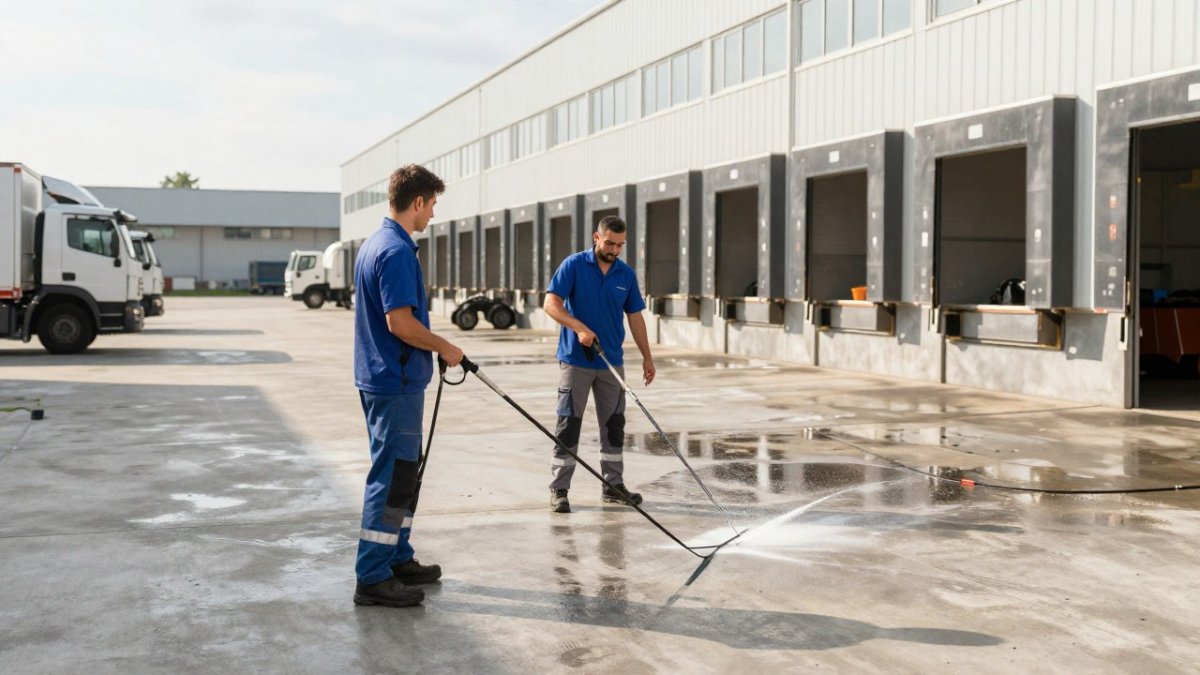
Timing matters too. Work done during off-shift hours or on weekends may require additional coordination, and that coordination shows up in the quote. Facilities that can give a contractor a consistent window often pay less than those that need to schedule around active truck traffic every visit.
Pricing depends on site conditions and scope, so confirm details directly with Tomicic's Pressure Washing & Sweeping. A site walk is the most reliable way to get an accurate figure.
Commercial Pressure Washing Cost: Typical Pricing Structures
Commercial pressure washing is commonly quoted in a few structures, including flat fees for a defined area, recurring contracts, and time-and-materials rates for one-time or emergency work. Each suits a different situation, and the right structure depends on how predictable the site's needs are.
What separates a fair quote from an inflated one is how the provider builds the number. Industrial quotes are often built from inputs such as square footage of cleanable surface, mobilization and setup time, and consumables such as detergent and fuel. A provider who can show those inputs is easier to compare than one who quotes a single lump sum.
Surface type changes the math. Smooth, sound concrete in a truck court cleans faster than cracked asphalt or a dock apron with years of oil buildup, because degraded surfaces need lower pressure, more passes, and sometimes a degreaser pre-treatment. Heavy oil staining and rubber tire marks typically require a detergent dwell time and a second pass, which adds labor hours and material cost. Sites with tight access, narrow gates, parked trailers, or active loading bays, slow the crew and raise the effective cost per square foot.
Frequency affects cost per visit. A site cleaned monthly spreads mobilization across more visits than a site cleaned twice a year. Bundling concrete yards, parking areas, building exteriors, and curb lines into one visit can also reduce setup and travel costs.
A practical way to budget is to ask for a written scope that lists each area, its square footage, the expected frequency, and any add-ons such as degreasing or after-hours work. Then request the same scope from two or three providers so the numbers are comparable. Pricing depends on quantity, dates, and site conditions, so no fixed figure applies across sites, confirm details directly with Tomicic's Pressure Washing & Sweeping.
The article points to a few concrete variables that shape how a commercial pressure washing quote is built.
| Cost factor | Effect on price | Note |
|---|---|---|
| Surface condition | Degraded surfaces cost more | Needs lower pressure and more passes |
| Heavy oil or tire marks | Adds labor and material | Requires detergent dwell time and a second pass |
| Tight site access | Raises cost per square foot | Narrow gates, parked trailers, active bays slow the crew |
| Cleaning frequency | Lowers cost per visit | Mobilization is spread across more visits |
| Bundled areas | Can reduce setup and travel | Yards, parking, exteriors and curb lines in one visit |
Choosing the Right Pressure: Why a Commercial Pressure Washer 4000 PSI Matters
Pressure rating affects both speed and surface safety. Higher pressure can clean heavy soil faster, but the same force can etch softer surfaces or damage sealants if misused. The right setting depends on the surface being cleaned, not on picking the highest number available.
Hiring a Service Versus Buying Equipment: Industrial Pressure Washing Equipment Cost
Owning industrial pressure washing equipment involves costs for the machine, hoses, nozzles, detergent systems, storage, maintenance, and an operator. For a site that needs cleaning once or twice a year, that investment is often hard to justify. For a site with daily or weekly needs, ownership can make sense.
Hiring a service generally converts those fixed costs into per-visit or monthly expenses, and transfers responsibility for equipment upkeep, training, and insurance to the provider. Compare total annual spend on both paths before deciding, including the staff time spent managing an in-house program.
Water Tank Units and Site Access: Commercial Pressure Washer With Water Tank Options
Water tank units are useful where a site has no nearby hose connection or where water access is restricted. Tank capacity limits run time, so operators usually plan refill intervals around the job size.
Site access also affects the schedule. Gated industrial zones, restricted truck routes, and wastewater rules can all shape how and when cleaning happens. Confirm access requirements early so they do not add delays later.
Scheduling, Compliance, and Vendor Questions to Ask Before You Book
Industrial cleaning is judged on two things beyond a clean surface: whether the runoff is handled lawfully and whether the work disrupts operations. Most consumer-facing pressure washing content skips both, so this is where a facility manager should focus.
Start with wastewater. Cleaning concrete, loading docks, and equipment yards produces runoff that can carry oil, grease, detergent, and suspended solids. Under the federal Clean Water Act, many industrial sites operate under stormwater permits that restrict non-stormwater discharges to storm drains, and local pretreatment programs may regulate what can enter the sanitary sewer. Check the applicable permit and local rules for your site. A responsible provider should explain how they contain and recover wash water rather than letting it run to a drain. Ask for that plan in writing and confirm it matches your site's stormwater pollution prevention plan.
Next, verify insurance and safety. Request a certificate of insurance showing general liability and workers' compensation coverage, and confirm the limits are adequate for your site. Ask how the crew handles safety procedures for your yard and equipment. A provider who cannot produce these documents quickly is a scheduling risk.
Then compare service levels on paper. A useful vendor comparison covers: written scope of work with areas and square footage; equipment capacity, including whether hot water and water tanks are available; response time for callbacks and emergency spills; references from similar industrial sites; crew consistency; and how missed or weather-delayed visits are handled. Ask whether after-hours or weekend scheduling is available and how it is priced, since cleaning around shifts and truck traffic is the main way to limit downtime.
Useful questions to put in writing: What is included in the scope, and what is excluded? How is after-hours work priced? What happens if weather delays the job? Can the same crew service the site each time? How is wastewater recovered and disposed of? Written answers make side-by-side comparison far easier and protect the site if a question arises later. Watch out: a low bid that cannot document wastewater handling or insurance is not affordable once compliance and liability are counted.
Requesting a Free Estimate for Your Industrial Site
The fastest route to an accurate price is a site walk. Share your square footage, the surfaces you need cleaned, how often you need service, and any access or timing constraints. Tomicic's Pressure Washing & Sweeping offers free estimates, which lets you compare scope and cost before committing. Request a free estimate from Tomicic's Pressure Washing & Sweeping to get a quote tailored to your site.
Frequently Asked Questions
How much does an industrial pressure washer cost?
Equipment prices vary widely with pressure rating, flow rate, engine type, and whether a water tank is included. Buying commercial-grade units is a capital expense, and the total depends on the model and accessories you need. Pricing for Tomicic's Pressure Washing & Sweeping services depends on site size, surface type, frequency, and access requirements. Contact the team for a free estimate tailored to your property.
What PSI is suitable for commercial pressure washing?
Many commercial jobs on concrete, parking lots, and loading docks are handled with pressure in the range of roughly 3000 to 4000 PSI, though the right setting depends on the surface and the soil or residue involved. Heavier grime is often tackled with higher pressure, but surfaces that are delicate or coated need lower pressure to avoid damage. Matching pressure, water flow, and nozzle type to the surface produces better results than chasing the highest PSI.
How often should industrial properties be pressure washed?
Frequency depends on traffic, weather, and the type of contamination on site. High-traffic yards and loading areas often benefit from regular cleaning, while properties with oil or chemical residue may need more frequent attention to meet internal safety standards. Many facility managers set a recurring schedule and add emergency cleanups as needed. A site assessment helps determine the right cadence for your operation.
Is it cheaper to hire a pressure washing company or buy commercial equipment?
For most industrial sites, hiring a service is more predictable because it avoids equipment purchase, storage, maintenance, and operator training. Buying commercial pressure washing equipment makes sense mainly when cleaning is frequent, in-house, and continuous. Compare the annual cost of owned equipment, including repairs and labor, against the cost of a recurring service plan before deciding.
