
Choosing Industrial Pressure Washing Equipment: A Buyer's Guide
Quick Summary
Choosing industrial pressure washing equipment starts with defining the surfaces and soils you need to clean, then matching PSI, GPM, water temperature, and power source to that work. For most commercial jobs, a unit rated 3,000 to 4,000 PSI with at least 4 GPM covers general cleaning of concrete and building exteriors.
- Define the job first by listing every surface, its material, condition, and soil type.
- Most commercial general cleaning works well at 3,000 to 4,000 PSI with at least 4 GPM.
- Compare PSI and GPM as rated at the nozzle, not just the pump's maximum.
- Choose hot water only when you regularly remove oil, grease, or gum; cold water handles dirt.
- Plan wash-water capture for parking garages, since discharge rules vary by jurisdiction.
Table of Contents
- Start With the Job: Defining Your Cleaning Application
- Commercial Pressure Washer PSI and GPM: What the Numbers Mean
- Hot Water vs. Cold Water Pressure Washers for Industrial Use
- Power Source, Portability and Duty Cycle
- Choosing a Pressure Washer for Parking Garage Cleaning
- Commercial Pressure Washer Accessories and Total Cost of Ownership
- Booking Your Equipment Decision With a Professional Site Assessment
- Frequently Asked Questions
Start With the Job: Defining Your Cleaning Application
Choosing industrial pressure washing equipment starts with the surface, not the machine. A washer that handles a shopping center's parking lot will struggle with a steel loading dock covered in oil, and a unit built for graffiti removal may be overkill for a residential driveway. Define the job first, then shop for the equipment.
Start by listing every surface you need to clean, along with its material, condition, and soil type. Concrete, asphalt, brick, painted metal, and sealed wood each respond differently to pressure and heat. Grease and oil call for hot water and detergent, while loose dirt and mildew usually need only cold water and time.
Watch out: buying for your heaviest occasional job rather than your most frequent one means paying for capacity you rarely use while running underpowered equipment every day. Plan for the work you do weekly, then add a separate contract for the rare emergency.
Commercial Pressure Washer PSI and GPM: What the Numbers Mean
PSI (pounds per square inch) measures the force of the water stream, while GPM (gallons per minute) measures how much water the unit delivers. Cleaning power depends on both: high PSI with low GPM can gouge concrete without moving much water, and high GPM at low PSI rinses well but lifts stubborn grime poorly.
For most commercial work, a unit in the 3,000 to 4,000 PSI range paired with 4 GPM or more covers general cleaning of concrete and building exteriors. Heavy industrial jobs such as removing old coatings or scale often call for more pressure, but more PSI is not automatically better. Excessive pressure can etch surfaces and drive water into cracks.
Compare the rated PSI and GPM at the nozzle, not just the pump's maximum. To decide how often a commercial property needs cleaning, read the guide to finding the right pressure washing frequency. Manufacturers sometimes quote figures that the unit never sustains in real use.
Matching Cleaning Units (CU) to Your Surfaces
Cleaning units (CU) are a common way to compare total cleaning output, calculated from PSI multiplied by GPM. A higher CU figure means more cleaning capacity per pass, which translates into faster jobs on large lots. Use CU to compare machines of similar type, and remember that it does not account for surface sensitivity or nozzle choice.
The article's key performance figures are summarised below so you can compare them at a glance.
| Item | Value | Note |
|---|---|---|
| General commercial PSI | 3,000 to 4,000 PSI | Covers concrete and building exteriors |
| Minimum GPM | 4 GPM | Paired with the PSI range for general cleaning |
| PSI definition | Pounds per square inch | Measures force of the water stream |
| GPM definition | Gallons per minute | Measures water volume delivered |
| Comparison point | Rated at the nozzle | Not just the pump's maximum |
Hot Water vs. Cold Water Pressure Washers for Industrial Use
Cold water units are the standard choice for dirt, mud, and general grime on concrete and siding. They are simpler, cheaper to run, and need less maintenance. Hot water units heat the water to dissolve grease, oil, and gum, which cold water often cannot lift from parking garage decks, kitchen exhaust areas, or equipment yards.
Many facilities need both. If your work is mostly parking lots and building exteriors, cold water handles the bulk of it. If you regularly degrease heavy machinery or remove oil stains, the added cost of a hot water unit is usually justified by faster, more thorough cleaning.
Hot water units cost more upfront and consume more fuel, so factor operating expense into any total cost comparison.
Power Source, Portability and Duty Cycle
Electric motors suit indoor work and sites with reliable power. Gas and diesel engines provide mobility and independence from outlets, which matters on large outdoor lots. Diesel-fired burners are common on hot water units and should be sized to your water heating needs.
Portability and stationary units serve different roles. Trailer-mounted units make sense for crews that move between sites daily. Stationary units can be a better fit for a single facility with consistent work.
Duty cycle describes how long a machine can run continuously before it needs a rest. Commercial work demands a high duty cycle, so check the rating before you buy. A unit rated for intermittent residential use will overheat during an eight-hour shift.
Choosing a Pressure Washer for Parking Garage Cleaning
Parking garages combine oil, salt, tire residue, and poor drainage, which makes them among the more demanding cleaning environments. For the surface itself, see how a professional cleans concrete parking garage floors. Look for a unit with enough GPM to flush contaminated water toward drains, a surface cleaner attachment for even coverage across wide decks, and hot water capability for oil spots. A surface cleaner also reduces overspray and keeps wash water more contained than a bare wand, which matters for the compliance reasons below.
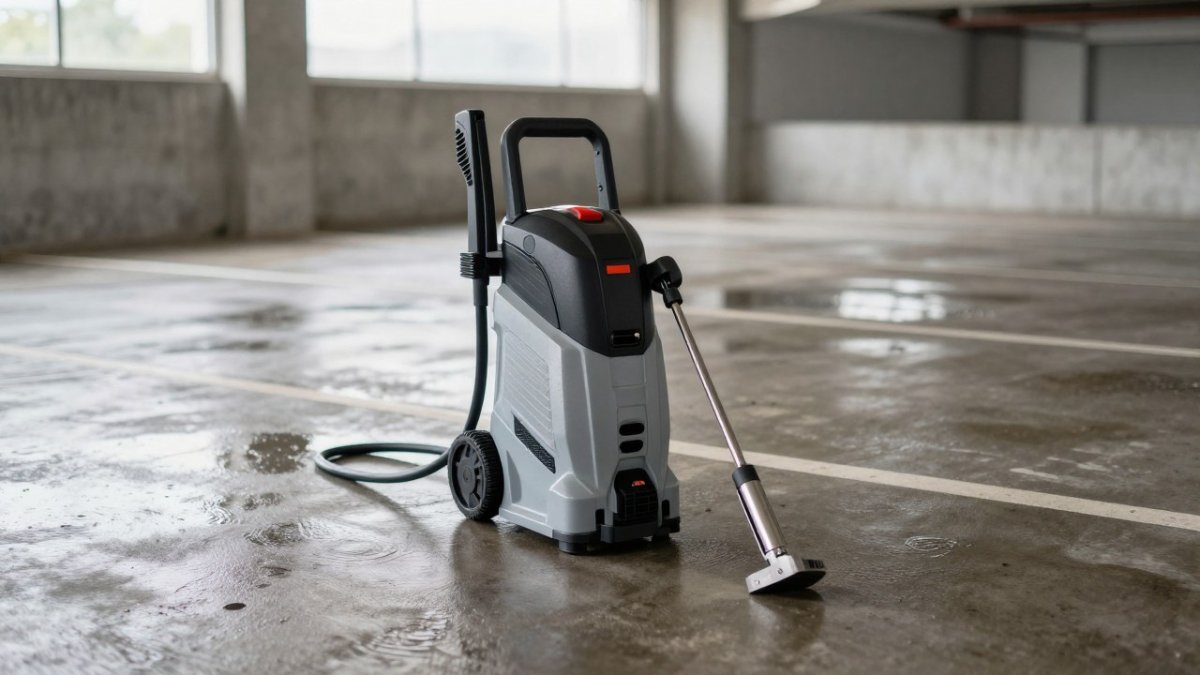
Water management is the part most equipment guides skip, and it is where garage cleaning goes wrong. Runoff from garage cleaning can carry oil, grease, detergents, and heavy metals. Wash water from garage cleaning can carry contaminants, and discharge rules for storm drains and sanitary sewers vary by jurisdiction. Confirm the requirements with your local stormwater program and sewer authority. Before you start, confirm with the local sewer authority and stormwater program what discharge route is allowed for your site.
That requirement changes the equipment decision. If wash water must be captured, you need a recovery system: a vacuum recovery surface cleaner, a wet/dry vacuum rated for water, containment berms, and a holding tank or filtration setup before discharge. A pressure washer chosen without accounting for recovery will produce a wash stream you cannot legally send to the storm drain. Size the recovery equipment to the washer's GPM, because a recovery unit that cannot keep up with the pump turns a compliant job into a flooded deck.
Hot water also interacts with compliance. Hot water lifts oil and grease more completely, which can reduce the detergent load in the runoff, but it does not remove the need to capture and manage the water. Treat hot water as a cleaning-performance choice and recovery as a separate compliance requirement.
Commercial Pressure Washer Accessories and Total Cost of Ownership
The machine is only part of the cost. Accessories such as surface cleaners, extension wands, rotating nozzles, hoses, and chemical injectors affect both results and wear, and the wrong accessory can shorten pump life. A surface cleaner that is undersized for the unit's GPM, for example, forces the pump to cycle against a restricted flow and accelerates seal wear. Match accessory flow ratings to the machine before you buy.
Budget for consumables on a schedule rather than as surprises: replacement hoses, pump oil and seals, inlet filters, nozzles, and detergent recur every season. Nozzle wear is easy to overlook because it is gradual. A worn nozzle enlarges its orifice, drops pressure at the tip, and makes the operator compensate with more trigger time, which burns fuel and labor. Most practitioners find that replacing nozzles on a fixed interval is cheaper than chasing the pressure loss.
Total cost of ownership includes purchase price, fuel or electricity, maintenance, repairs, downtime, labor, and expected service life. The purchase price is usually the smallest line over a five-to-seven-year horizon. To compare machines fairly, build a simple annual model:
- Acquisition: purchase price plus freight, setup, and any trailer or mounting hardware.
- Energy: fuel or electricity per operating hour, multiplied by your estimated annual hours. Hot water units add burner fuel on top of pump power.
- Maintenance: pump oil, seals, filters, nozzles, and belts on the manufacturer's interval, priced from current parts quotes.
- Repairs and downtime: a reserve for unplanned failures, plus the labor cost of idle crew time when a unit is down during peak season.
- Labor: operator hours per job, which fall as cleaning units (CU) rise, so a higher-output machine can pay back through faster jobs.
- Service life and resale: a well-built unit with available parts typically holds value and stays in service longer than a light-duty unit pushed into commercial work.
A cheaper unit that breaks down during peak season can cost more than a pricier, well-built machine. The mechanism is downtime: if a crew of two idles for a day because a pump seal failed and no local parts stock exists, the lost labor and rescheduled work often exceed the price difference between the two machines. Ask suppliers for maintenance schedules, parts availability, and typical lead times on pumps and burners before you decide. A unit whose parts ship in days is worth more than one whose parts ship in weeks.
Pricing for any specific machine depends on configuration, accessories, and supplier, so request a current quote from Tomicic's Pressure Washing & Sweeping or the equipment supplier. When you compare quotes, ask each supplier to itemize the same accessory package and the same maintenance kit so the totals are comparable.
Booking Your Equipment Decision With a Professional Site Assessment
If you are weighing whether to buy equipment or hire a service, a site assessment can settle the question. You can request a free quote from Tomicic's Pressure Washing & Sweeping's commercial pressure washing team for your site, or review their pressure washing and street sweeping services to see what is covered.
Tomicic's Pressure Washing Service, LLC was incorporated in California in 2006, and the company offers 24/7 emergency call-outs for commercial and industrial properties.
Frequently Asked Questions
What type of pressure washer do professionals use?
Most professional crews use gas or diesel-powered units for mobile jobs and electric units for indoor or fixed sites where a generator is impractical. Professional-grade models typically have a commercial-duty pump, a stainless or brass manifold and a high duty cycle, which lets them run through a full shift without overheating. Hot water units are common for degreasing oil and grease, while cold water units handle general washing and sidewalks. The right choice depends on the surface, the contaminant and how many hours per day the machine must run.
How many GPM and PSI do I need from a commercial pressure washer?
PSI measures cleaning force, while GPM measures water volume, and both matter. For most concrete, parking lot and general commercial work, many operators look for roughly 3,000 to 4,000 PSI paired with enough GPM to rinse loosened grime quickly. Heavy scale or paint removal may call for more pressure, but excess PSI can etch concrete or damage surfaces. Check the cleaning unit rating, which combines pressure and flow, and match it to the surface you clean most often.
Should I choose a hot-water or cold-water industrial pressure washer?
Choose a hot-water unit if you regularly remove oil, grease or gum, since heat breaks down these contaminants faster and reduces chemical use. Cold-water units are lower cost, simpler to maintain and sufficient for dirt, mud and general grime on sidewalks and parking lots. Many facilities own both, using hot water for oil-prone areas such as loading docks and cold water for routine maintenance. Factor fuel or electricity for the heater into your total operating cost.
What accessories do I need for industrial pressure washing?
Most commercial setups include a surface cleaner for wide, even passes on flat concrete, a set of nozzles with different spray angles, a high-pressure hose rated for the unit's PSI, and a chemical injector for detergents and degreasers. A thermal relief valve and a reliable unloader valve help protect the pump when the gun is closed. Extension wands and a trigger gun with a safety lock also improve operator control and safety on large sites.
