

How Often Should Apartment Breezeways Be Pressure Washed?
Last Updated: November 7, 2026
Quick Summary
For most apartment buildings, how often should apartment breezeways be pressure washed has a practical answer: every three to six months. A reasonable starting point is every four months, then adjusted for foot traffic, weather exposure, and surface material. Move the date up whenever buildup or slickness appears.
- Light use in a mild climate suggests washing every six months.
- Heavy use in a humid or wet climate suggests every two to three months.
- Walk the breezeway monthly and watch for visible buildup, slick spots, and odor.
- Treat slickness as a safety signal that calls for an earlier cleaning.
- Test a small area first and start with the lowest effective pressure.
Table of Contents
- Why Breezeway Cleaning Frequency Varies by Property
- Baseline Schedule: How Often Most Apartment Breezeways Need Pressure Washing
- Apartment Complex Pressure Washing Schedule: Planning Cleanings Across Multiple Buildings
- Apartment Breezeway Cleaning Checklist: Preparing the Area and Equipment
- Safe Pressure and Surface-Specific Cleaning for Concrete, Stairs and Landings
- What Apartment Pressure Washing Costs and What Affects the Price
- Booking Your Next Breezeway Cleaning With Tomicic's
- Frequently Asked Questions
Why Breezeway Cleaning Frequency Varies by Property
For most apartment buildings, the question of how often should apartment breezeways be pressure washed has a practical answer: every three to six months. The right interval depends on how many residents walk the space, how much weather it takes, and what the surface is made of. Two buildings with the same layout can need very different schedules.
Property managers often ask for one fixed number, which leads to two problems: breezeways washed too rarely turn slick with algae, and those washed too often drain the budget. A better approach starts with a baseline and adjusts for the conditions that drive grime.
Several factors push the schedule up or down:
- Foot traffic: Breezeways used by many residents collect dirt and grime faster.
- Weather exposure: Open-air corridors in humid or rainy areas grow algae sooner.
- Surface material: Concrete holds stains differently than coated or sealed surfaces.
- Building layout: Double breezeways and three-story buildings have more surface to maintain.
- Shade and drainage: Spots that stay wet or shaded develop mold and odor faster.
Baseline Schedule: How Often Most Apartment Breezeways Need Pressure Washing
A reasonable starting point for anyone asking how often should apartment breezeways be pressure washed is every four months, though the right interval varies by property.
- Light use, mild climate: Every six months
- Average use, mixed climate: Every four months
- Heavy use, humid or wet climate: Every two to three months
Track what you see rather than relying only on a calendar. Walk the breezeway monthly and note visible buildup, slippery spots, and odor. When any appear before the scheduled date, move the next cleaning up.
Watch out: Waiting until a breezeway looks obviously dirty usually means algae has already built up. Treat slickness as a safety signal to clean, not a cosmetic problem.
Adjusting the Schedule for High-Traffic and Low-Traffic Buildings
High-traffic breezeways, such as those near a main entrance or parking area, should move toward the shorter end of the range. Residents carry in dirt, food, and moisture all day, and that residue builds up quickly.
Low-traffic breezeways, like those at the back of a complex or serving only a few units, can often stretch to five or six months. Still, keep an eye on shaded corners. Low traffic does not mean low moisture.
If one building is much busier than another, give it its own schedule. One rule across all properties tends to overclean some and underclean others.
Weather, Climate and Seasonal Cleaning Schedules
Climate affects frequency more than most managers expect. Humid areas, shaded courtyards, and frequent rain support algae and mildew year-round, while dry, sunny climates slow growth but still allow dust and grime to accumulate.
Many property managers find that a seasonal plan works well:
- Spring cleaning: A thorough wash after winter to remove salt residue, leaves, and built-up grime.
- Summer maintenance: A lighter pass if the area is humid or gets heavy use.
- Fall cleaning: A wash before leaf fall and wet weather to reduce slippery buildup.
- Winter check: A visual inspection, with a spot cleaning if needed.
The right interval depends on how heavily the breezeway is used and how wet or humid the climate is.
Conditions |
Suggested interval |
Adjustment signal |
|---|---|---|
Light use, mild climate |
Every six months |
Slick spots or odor appear |
Average use, mixed climate |
Every four months |
Visible buildup between visits |
Heavy use, humid or wet climate |
Every two to three months |
Algae or mildew returns quickly |
Apartment Complex Pressure Washing Schedule: Planning Cleanings Across Multiple Buildings
When you manage several buildings, a shared calendar saves time and money. Group buildings with similar traffic and climate exposure, then assign each group a cleaning window.
A simple planning approach:
- List every building and its breezeway count.
- Rate each building as low, average, or high traffic.
- Note its exposure: shaded, sunny, or wet.
- Assign a cleaning interval based on those ratings.
- Block out the dates on one master calendar.
Schedule cleanings for quieter days and give residents advance notice so they can move vehicles, bikes, and planters away from the walkway.
For a deeper look at building recurring cleanings across shared properties, see our guide on scheduling recurring shopping center cleaning.
Apartment Breezeway Cleaning Checklist: Preparing the Area and Equipment
Good preparation makes a pressure wash faster and safer. Before the crew arrives, clear the walkway of loose debris, sweep away leaves and trash, and move furniture or planters.
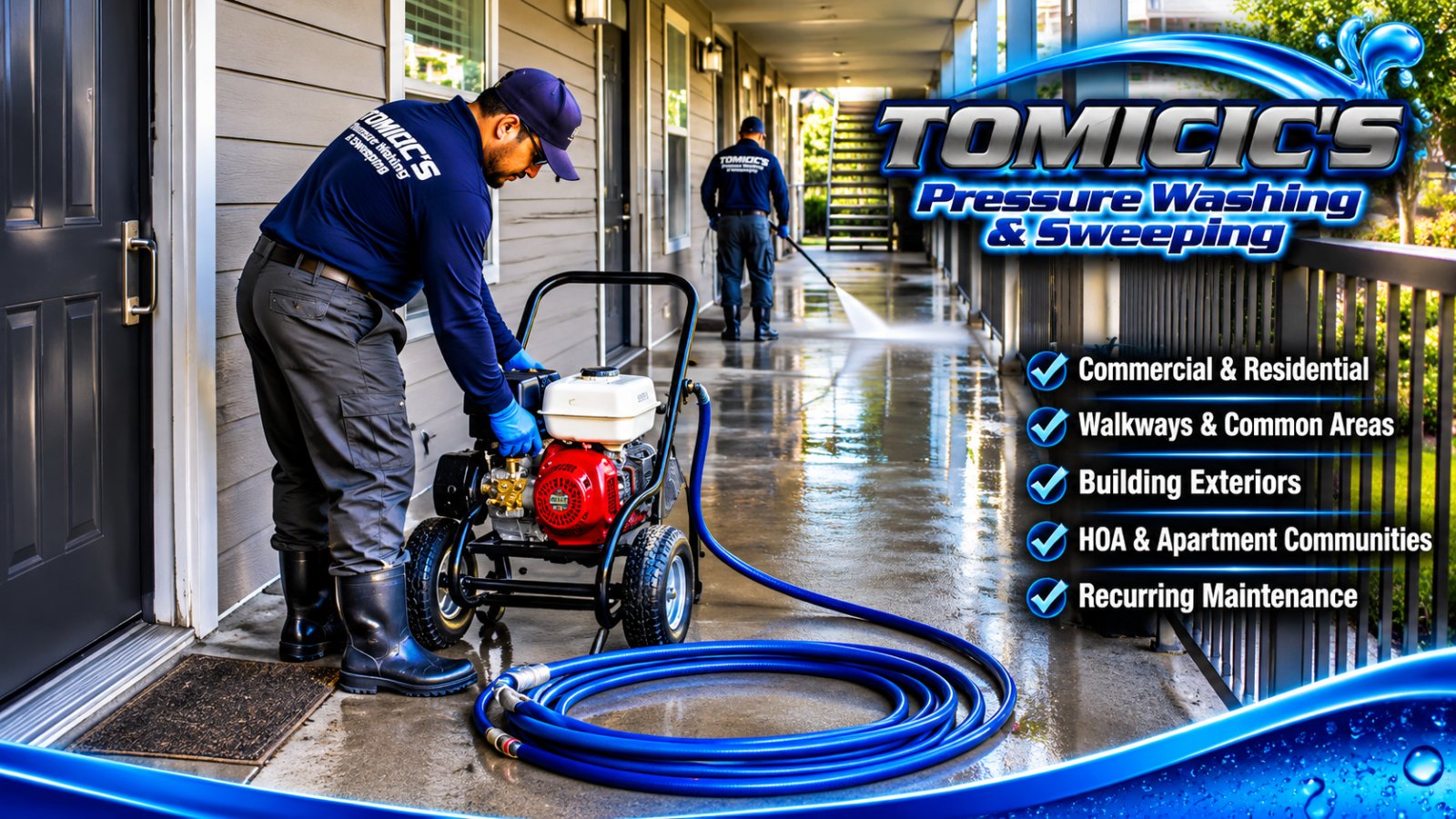
Maintenance crew setting up a pressure washer on an apartment building concrete breezeway.
Use this checklist before every job:
- Clear debris, leaves, and trash from the breezeway
- Move planters, bikes, and small furniture out of the work zone
- Notify residents of the cleaning date and time window
- Check drains and gutters for blockages
- Confirm water access and hose length
- Inspect the surface for cracks or loose tiles before spraying
- Set up signage to warn people of wet surfaces
If the breezeway has heavy debris or track-out from nearby work, a sweeping pass first helps. Our construction street sweeping services handle that kind of pre-wash cleanup for job sites and high-debris areas.
The crew also needs the right equipment: a pressure washer sized for concrete, the correct nozzle, and a surface cleaner for wide areas.
Safe Pressure and Surface-Specific Cleaning for Concrete, Stairs and Landings
Pressure washing a breezeway is not the same as washing a driveway. The surface is shared with residents, the water has to go somewhere, and nearby fixtures, lights, outlets, door thresholds, railings, are not designed to be blasted.
Concrete walkways and landings.
Stairs and stair pans.
Painted and coated surfaces.
Metal railings, unit doors, light fixtures, and outlet covers should be protected or avoided. Cover or bag fixtures before washing, and keep the wand away from door thresholds and weatherstripping.
Overspray kills grass, strips mulch, and stains parked cars. Pre-wet nearby plants, direct runoff away from beds, and ask residents to move vehicles out of the splash zone.
Water management and building protection. This is the part most guides skip. Before the first spray, confirm that drains and gutters are clear so water does not pool on the walkway or back up into stairwells. Check that door thresholds sit above the runoff path and that water will not run under unit doors.
Wet breezeways are a slip hazard, especially right after washing and during drying. Post wet-floor signage at every entrance, block off sections as the crew moves through, and notify residents in advance with a clear time window. Ask residents to keep pets inside and move bikes, planters, and furniture off the walkway. Schedule work for mid-morning to early afternoon on weekdays, avoiding commute hours.
A repeatable inspection standard. Rather than relying on a calendar alone, walk each breezeway monthly and score it against observable triggers:
- Visible dark staining or green algae on concrete or railings
- Slick or slippery spots, especially in shaded corners and under roof drip lines
- Persistent odor near drains or in low-lying areas
- Accumulated leaves, pollen, or debris in corners and stairwells
- Water pooling that does not drain within a few hours of rain
When any two triggers appear, move the next cleaning up. This gives property managers a defensible standard tied to what residents actually experience, not just a schedule.
Always test a small area first, start with the lowest effective pressure, and increase only if needed. That single habit prevents most surface damage and keeps the work predictable from building to building.
What Apartment Pressure Washing Costs and What Affects the Price
Cost is where most property managers want a straight answer. Pricing for breezeway work depends on the scope of the job, and Tomicic's Pressure Washing & Sweeping offers tailored service packages sized to each property's budget and needs. Request a free estimate for pricing based on your site.
- Square footage and number of levels: A three-story breezeway has roughly three times the walking surface of a single-story one, plus stair treads and landings that take longer per square foot than flat concrete. Multi-level buildings also require more hose management and setup time.
- Buildup severity: Light dust and pollen wash off quickly. Heavy algae, mold, and embedded grime require pre-treatment, dwell time, and sometimes a second pass. A breezeway that has gone two years without cleaning can cost noticeably more than one on a four-month cycle.
- Surface type: Bare concrete is the most forgiving and usually the least expensive to clean. Painted or sealed surfaces, wood railings, and metal stair pans require lower pressure or soft washing, which adds time and sometimes chemical cost.
- Access and water: If the crew can hook up to a nearby spigot, setup is fast. If water has to be hauled or hose runs are long, labor time goes up. Gated communities, locked utility rooms, and parking layouts that block equipment access all add cost.
- Scheduling and frequency: Recurring contracts are almost always cheaper per visit than one-time jobs. The crew knows the layout, plans the route, and can bundle nearby buildings into a single trip. A property that books quarterly service typically pays less per visit than one that calls only when the breezeway looks bad.
Watch out: A very low per-visit quote often signals a scope that excludes pre-treatment, stair detail work, or runoff control. Ask what the price covers before comparing bids, because a cheap wash that leaves algae behind or damages a coating costs more to fix than a properly scoped job.
The preventive-maintenance trade-off is worth modeling. A four-month cycle keeps each visit a maintenance wash rather than a restoration job. Stretch the interval to 12 or 18 months and the crew faces embedded growth, stained concrete, and slippery surfaces that create liability exposure.
Booking Your Next Breezeway Cleaning With Tomicic's
Keeping apartment breezeways clean protects residents, improves curb appeal, and helps your property pass inspections. Start with a baseline of about four months, adjust for traffic and climate, and move the date up whenever buildup or slickness appears.
If you want help setting up a schedule, the team at Tomicic's Pressure Washing & Sweeping can review your buildings and recommend a plan. Contact us today to request a free estimate and get your breezeways on a cleaning schedule that fits your property.
Frequently Asked Questions
How often should apartment breezeways be pressure washed?
Most apartment breezeways benefit from pressure washing two to four times per year, with high-traffic buildings or those exposed to heavy dirt, leaf litter or staining needing more frequent attention. Sites near busy roads, with heavy foot traffic or with algae in shaded areas often schedule a cleaning every quarter. Lower-traffic, well-shaded buildings may be fine with a twice-yearly schedule. Review visible buildup, slip hazards and resident complaints each season to adjust the cadence.
What is the best time of year to pressure wash apartment breezeways?
Spring and early fall are usually the best windows, because they clear winter grime and summer dust and prepare surfaces for the seasons ahead. Avoid cleaning during freezing temperatures, when water can refreeze and create slip hazards. Scheduling cleanings outside peak move-in and move-out periods also reduces disruption for residents. Coordinate timing with the property's overall exterior maintenance plan for the year.
How much does it cost to pressure wash an apartment complex?
Apartment pressure washing costs depend on the total square footage, number of buildings, surface type, level of staining and how many breezeways and stairwells are included. Tomicic's offers tailored service packages sized to each property's budget and needs, so pricing is set after reviewing your site. Request a free estimate to get a quote based on your actual layout and traffic. Bundling recurring service across buildings often makes the per-building cost more predictable.
Can pressure washing damage breezeway surfaces?
It can, if the pressure is too high or the nozzle is held too close to the surface, especially on older concrete, painted surfaces or worn stair treads. Surface-appropriate pressure settings, correct nozzle selection and, where needed, low-pressure soft washing reduce that risk.
