

How to Remove Graffiti From Concrete: Step-by-Step
Table of Contents
- Assessing the Graffiti and Choosing Your Removal Method
- Best Graffiti Remover for Concrete: Product Selection and Safety
- How to Remove Spray Paint From Concrete: Application and Dwell Time
- Pressure Washing Graffiti Off Concrete: Technique and Settings
- Handling Paint Shadows and Residual Stains
- Concrete Graffiti Removal Cost and When to Call a Professional
- Protecting Your Concrete and Preventing Future Graffiti
- Frequently Asked Questions
Last Updated: October 16, 2026
Assessing the Graffiti and Choosing Your Removal Method
Graffiti on concrete damages property value and creates safety concerns. Before you remove graffiti from concrete, understand what you're dealing with: paint types and surface conditions require different approaches, and fresh tags respond differently than old, weathered paint.
Identifying Paint Type and Surface Condition
Spray paint varieties behave differently on concrete. Oil-based spray paint penetrates deeper and bonds stronger. Water-based or acrylic spray paint sits more on the surface. Lacquer-based paint hardens quickly and resists solvents.
New graffiti is easier to remove; paint exposed to sun and weather for months becomes harder to dissolve. Run your finger across a test area, sticky paint suggests fresh application, flaky paint means it's older and may need more aggressive treatment.
Examine the concrete itself. Porous concrete absorbs paint deeper, sealed concrete keeps paint on the surface, textured concrete traps paint in its grooves, and smooth concrete allows cleaner removal. Look for cracks where paint has seeped in.
Selecting the Right Approach for Your Concrete
Three main removal methods exist: chemical treatment, pressure washing, and combination approaches. Your choice depends on paint type, surface condition, and acceptable damage risk.

Chemical treatment alone works best for fresh paint on sealed concrete, dissolving paint without harming the substrate. It takes time but offers control.
Pressure washing alone works for old, weathered paint on tough concrete, but high pressure can damage softer surfaces or create etching marks.
Combination treatment uses chemicals to soften paint, then pressure washing to remove residue, handling stubborn graffiti while minimizing surface damage.
For cracked or deteriorating concrete, chemical treatment is safer; for new, strong concrete with fresh paint, pressure washing delivers faster results.
Best Graffiti Remover for Concrete: Product Selection and Safety
Choosing the right cleaner is critical, the wrong product wastes time, damages concrete, or fails to remove paint completely. Three categories exist: chemical solvents, alkaline cleaners, and specialty formulations.
Chemical Cleaners and Solvents
Paint thinners and mineral spirits dissolve oil-based spray paint by breaking down its chemical bonds. They're affordable, but flammable and toxic, so proper ventilation is essential.
Acetone-based removers work on lacquer and some acrylic paints. They evaporate quickly, meaning fast action but shorter dwell time, and are expensive and hazardous to handle.
Alkaline concrete cleaners use pH chemistry to lift paint from porous surfaces.
TSP (trisodium phosphate) is a traditional, inexpensive, moderately effective alkaline cleaner used for decades on masonry and brick, but it can leave residue and may require multiple applications.
Specialty graffiti removers like Terminator-HG and Graffiti Remover Pro combine active ingredients to handle various paint types. They cost more but often work faster and more thoroughly.
Safety Precautions and Protective Equipment
Chemical graffiti removers are hazardous. Proper protection prevents injury and illness.
Wear chemical-resistant gloves. Latex won't protect against solvents, use nitrile or butyl rubber gloves rated for your cleaner.
Use eye protection. Splashes cause serious eye damage. Safety glasses or a full face shield are essential.
Wear a respirator. Solvent fumes cause respiratory damage; a P100 respirator rated for organic vapors and particulates is necessary.
Ensure adequate ventilation. Work outdoors when possible; indoors, open doors and windows and use fans.
Protect your skin. Wear long sleeves and pants. Some cleaners burn exposed skin. Cover any cuts or abrasions before starting.
Check the product's safety data sheet (SDS) before use for hazards, required PPE, and first aid measures.
How to Remove Spray Paint From Concrete: Application and Dwell Time
The removal process follows a proven sequence. Rushing compromises results; patience and precision deliver better outcomes.
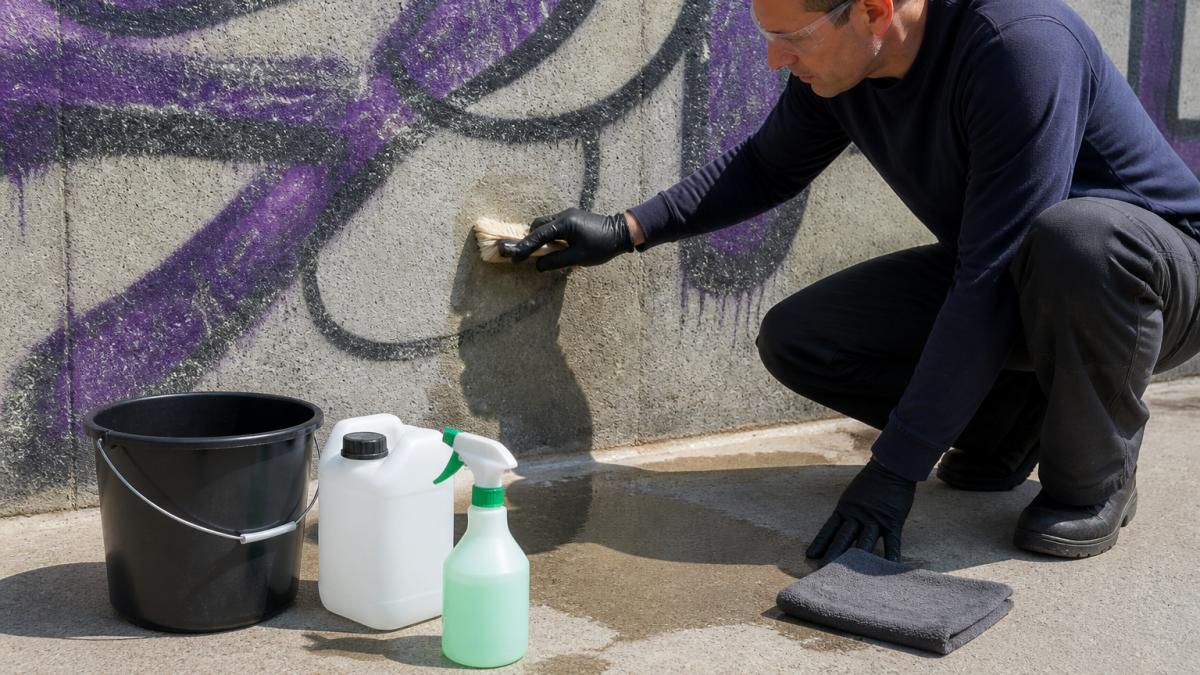
Preparing the Surface and Testing
Start by cleaning the area with a stiff brush or broom, removing loose dirt, debris, and dust so the cleaner contacts the paint directly.
Test your chosen cleaner on a hidden area first. Apply a small amount to an inconspicuous spot, wait the recommended dwell time, and check the results. Does the paint loosen? Does the concrete show damage or discoloration? This test prevents surprises on visible surfaces.
Document the test results, how long the paint took to respond, any concrete damage or color changes, to guide your full treatment plan.
Applying Cleaner and Allowing Proper Dwell Time
Apply the cleaner generously to the graffitied area using a brush, roller, or spray bottle. Ensure complete coverage, paint that's missed won't dissolve.
Dwell time is critical. This is the time the cleaner sits on the paint, breaking down its bonds. Follow the product instructions exactly.
During dwell time, keep the surface wet. Reapply cleaner if it begins drying, evaporation reduces effectiveness. In hot weather, reapply every 10 to 15 minutes.
Watch for signs of progress: the paint may bubble, wrinkle, or change color. Don't interrupt the process early.
Scrubbing and Loosening the Paint
After dwell time expires, scrub the area with a stiff-bristled or wire brush, applying firm pressure in circular motions and back-and-forth strokes.
The goal is to loosen the paint without gouging the concrete, you're breaking its bond with the surface, not removing all paint in this step.
For stubborn areas, use a plastic scraper. Avoid metal scrapers on concrete, which gouge and damage the surface.
Reapply cleaner as you scrub to keep the surface wet and help the paint lift. After scrubbing, let the area sit for another 10 to 15 minutes. Old or thick paint may need a second application and scrubbing session.
Pressure Washing Graffiti Off Concrete: Technique and Settings
Pressure washing removes loosened paint and cleans the surface. Incorrect pressure or technique damages concrete. Proper settings deliver clean results without harm.
Pressure Washer Settings and Nozzle Selection
Pressure matters. Most concrete can handle 3,000 to 4,000 PSI (pounds per square inch). Older or softer concrete may need only 2,000 to 3,000 PSI.
Nozzle selection controls pressure distribution. A 25-degree nozzle spreads pressure over a wider area, reducing intensity; a 15-degree nozzle concentrates it.
Never use a 0-degree nozzle on concrete. This creates a pencil-thin jet that cuts into the surface. It's useful for metal or masonry but damages concrete.
Water temperature matters. Hot water (140 to 180 degrees Fahrenheit) enhances cleaning power. Cold water works but requires higher pressure or longer dwell times.
Distance affects results. Hold the nozzle 12 to 18 inches from the surface. Too close risks damage; too far reduces effectiveness.
Rinsing and Removing Stubborn Paint Residue
Begin rinsing from the top of the graffitied area and work downward, so dirty water doesn't run over already-cleaned sections.
Use smooth, overlapping strokes, moving the nozzle side to side in a controlled pattern.
After the initial rinse, inspect the area. Some paint residue usually remains; a second application of chemical cleaner followed by another pressure wash often completes the job.
For particularly stubborn paint, repeat the chemical treatment and pressure washing cycle. Most graffiti comes off within two cycles; thick or old paint occasionally requires three.
After final rinsing, allow the concrete to dry completely. Wet concrete shows residual stains that may disappear when dry. If stains remain, additional treatment is needed.
| Step | Time | Frequency |
|---|---|---|
| Surface prep and testing | 10-15 minutes | Once |
| Apply cleaner and dwell | 20-60 minutes | 1-2 times |
| Scrub and loosen paint | 10-15 minutes | 1-2 times |
| Pressure wash | 10-20 minutes | 1-2 times |
| Final inspection and dry | 30+ minutes | Once |
Handling Paint Shadows and Residual Stains
Even after successful paint removal, a shadow or faint stain often remains because pigment penetrates the concrete surface. The paint itself is gone, but discoloration persists.
Paint shadows are common on porous concrete: pigment soaks into tiny pores and cracks. Chemical cleaners and pressure washing remove the paint itself but can't extract absorbed pigment.

Several options address paint shadows:
Etching treatment uses acid to open the concrete's surface and remove stained layers. This works but risks further damage to already-compromised surfaces, and professional-grade etching requires experience.
Concrete stain removers are designed specifically for residual discoloration, with different active ingredients than paint removers.
Repainting or sealing covers the shadow. A fresh coat of paint or a concrete sealer masks the discoloration, often the most practical solution for residential properties.
Accepting the shadow is sometimes the best choice. A faint shadow is far preferable to concrete damage from aggressive removal attempts.
Test any shadow-removal method on an inconspicuous area first. What works on one concrete type may damage another.
Concrete Graffiti Removal Cost and When to Call a Professional
DIY removal saves money but requires time, equipment, and effort. Professional services cost more but guarantee results and protect your property.
DIY Cost Breakdown
Chemical cleaner: $15 to $50 per gallon depending on type. Most small jobs use one gallon or less.
Pressure washer rental: $40 to $80 per day. Many hardware stores rent equipment. Alternatively, buy a consumer pressure washer for $300 to $800.
Safety equipment: $30 to $75 for gloves, respirator, eye protection, and other PPE.
Tools: $20 to $50 for brushes, scrapers, and application supplies.
Total DIY cost: $105 to $255 for a single graffiti removal on a small area. Larger areas or multiple tags increase costs.
This assumes water access and basic tools. If you purchase a pressure washer, initial investment reaches $400 to $900; subsequent jobs cost only materials.
Professional Services and Same-Day Options
Professional graffiti removal typically costs $200 to $600 per job depending on size and complexity. Tomicic's Pressure Washing & Sweeping offers same-day services for commercial and industrial properties. Our team handles assessment, chemical treatment, pressure washing, and final inspection.
Professional advantages include:
- Speed: Experienced teams complete jobs in hours, not days
- Equipment: Commercial-grade pressure washers and cleaners deliver superior results
- Expertise: Professionals assess surface damage and choose appropriate methods
- Liability: Professional services carry insurance covering any damage
- Convenience: You avoid hazardous chemicals and demanding work
For commercial properties with multiple tags or frequent graffiti, professional service is cost-effective.
For residential properties, one or two tags yearly justify DIY removal; frequent graffiti suggests professional service.
Protecting Your Concrete and Preventing Future Graffiti
Prevention is more cost-effective than removal. Several strategies reduce future graffiti incidents.
Anti-graffiti coatings create a sacrificial barrier.
Protective sealers don't prevent graffiti but make removal easier. They reduce paint penetration and protect concrete from chemical damage during removal.
Lighting and visibility deter graffiti. Well-lit areas are less attractive to vandals; motion-sensor lights are particularly effective.
Maintenance and rapid removal sends a message.
Fencing and barriers physically prevent access to vulnerable surfaces without compromising aesthetics.
Community engagement reduces graffiti in residential areas. Neighborhood watch programs and community events create social pressure against vandalism.
For commercial properties, combine anti-graffiti coatings, lighting, and rapid removal. For residential properties, maintenance and rapid removal often suffice.
Graffiti removal requires the right approach for your situation.
At Tomicic's Pressure Washing & Sweeping, we assess each graffiti situation and recommend the best removal method. We use professional-grade equipment and proven techniques to remove paint while protecting your concrete. Request a free estimate to discuss your graffiti removal needs.
Frequently Asked Questions
What chemical is most effective for removing graffiti from concrete?
Chemical graffiti removers containing solvents or alkaline cleaners work best, depending on paint type. For spray paint, solvent-based removers penetrate and dissolve the paint effectively. Alkaline cleaners work well on porous concrete surfaces. Always test your chosen cleaner on a hidden area first to ensure it won't damage or discolor the concrete, then follow the manufacturer's dwell time instructions before scrubbing and rinsing.
Can pressure washing alone remove graffiti without chemicals?
Pressure washing alone can remove some fresh graffiti, but chemical treatment first is more effective for stubborn or dried paint. Pressure washing works best after applying a graffiti remover and allowing proper dwell time to soften the paint. Using 3000-4000 PSI with a 25-degree nozzle helps remove loosened paint without etching or damaging the concrete surface.
How long should graffiti remover sit on concrete before scrubbing?
Dwell time typically ranges from 15 minutes to several hours, depending on the product and paint age. Fresh spray paint may need only 15-30 minutes, while older, stubborn graffiti requires longer penetration time, sometimes up to 24 hours. Always check your specific product instructions. Longer dwell times allow the cleaner to dissolve and loosen the paint, making scrubbing and removal much easier.
What's the typical cost to remove graffiti from concrete professionally?
Professional graffiti removal costs vary based on coverage area, paint type, and concrete condition. Commercial properties with larger affected areas typically cost more. Professional same-day emergency services are available for urgent commercial and industrial situations.