

7 Steps to Clean Spills and Prevent Workplace Falls
Last Updated: November 22, 2026
Quick Summary
Secure the area with wet-floor signs and barriers, then identify the spill type before choosing your PPE, absorbent, and cleaner. Complete spill cleanup by absorbing, cleaning, and fully drying the floor, and only remove signs after a hand or shoe check confirms the surface is dry.
- Report the spill and notify a supervisor within 5 minutes of discovery.
- Routine spills should be cleaned and dried within 30 minutes.
- Never mop oil into a thin film; absorb it first with an oil-only absorbent.
- Treat unlabeled substances as chemical spills and escalate rather than clean.
- Check spill kits monthly, since missing gloves make a kit unusable.
Table of Contents
- Why Prompt Spill Cleanup Prevents Workplace Falls
- The Workplace Spill Cleanup Procedure, Step by Step
- Wet Floor Safety Procedures: Signs, Barriers, and Safe Routing
- Chemical Spill Cleanup at Work: When to Stop and Escalate
- Spill Cleanup Equipment Every Site Should Stock
- Housekeeping Habits That Keep Floors Clear and Dry
- Request a Free Estimate for Scheduled Spill Response and Floor Care
- Frequently Asked Questions
Why Prompt Spill Cleanup Prevents Workplace Falls
A spill that sits for ten minutes is a hazard. A spill that sits for an hour is a liability claim waiting to happen. That's the core reason spill cleanup has to be treated as an emergency task, not a chore for later.
Slips, trips, and falls remain among the most common causes of workplace injury in the United States, according to OSHA's guidance on walking-working surfaces. Most of those incidents are preventable with fast, disciplined response.
The spill itself rarely causes the fall. The delay does.
Common Causes of Slippery Floors at Work
Most slippery floors come from a short list of culprits:
- Liquid spills from drinks, water coolers, or leaking equipment
- Oil and grease tracked in from parking lots and loading docks
- Rainwater carried in on shoes during storms
- Cleaning residue left behind by a wet mop
- Loose debris like paper, wrappers, or packing material
- Cords and boxes left in walkways and aisles
The first four create a slippery floor. The last two create trip hazards. Both fall under the same rule: clean promptly, or block the area until someone can.
The Workplace Spill Cleanup Procedure, Step by Step
Every site needs a written workplace spill cleanup procedure. It removes guesswork and keeps every employee responding the same way. The sequence below is the baseline; the spill-type table that follows is what turns a generic procedure into one workers can actually execute.
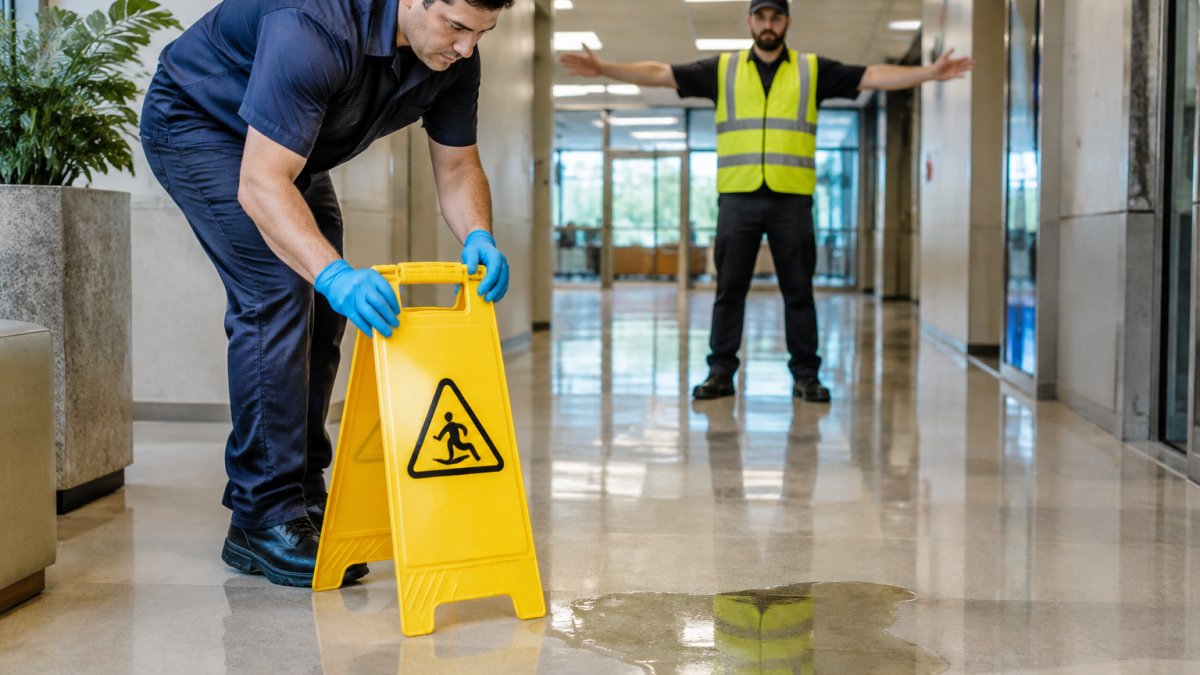
Step 1: Secure the Area and Warn Pedestrians
Stop the spill from spreading and stop people from walking into it.
- Call out the hazard to anyone nearby.
- Place a wet-floor sign at each approach to the spill.
- Block off the area with cones or a barrier if the spill is large.
- Route visitors and staff around the hazard, not through it.
- Report the spill to a supervisor so the response is logged.
Step 2: Identify the Spill Type Before You Touch It
Most cleanup mistakes happen in the first thirty seconds, when someone grabs a mop without looking. Pause and classify the spill: water, oil or grease, food and drink, chemical, or bodily fluid. The class determines your PPE, your absorbent, your cleaner, and whether you clean it at all. If you cannot identify the substance, treat it as a chemical spill and escalate.
Step 3: Clean, Dry, and Verify the Floor
Cleaning is only half the job. Drying and checking the surface is what actually prevents the next fall.
- Put on gloves and any PPE the spill requires.
- Absorb the liquid with the right material for the spill type.
- Clean the area with the correct cleaner and a mop.
- Dry the floor completely with a dry mop or blower.
- Run a hand or shoe across the surface to confirm it's dry.
- Remove signs and barriers only after the floor passes that check.
Watch out: reopening an area while it still feels tacky or damp is a common cause of a repeat incident.
Spill-Specific Procedures
Use the row that matches the spill. When a spill spans two categories, follow the more cautious procedure.
Oil and grease (loading docks, kitchens, equipment). Do not mop oil into a thin film, that spreads the hazard across the whole aisle.
Food and drink (break rooms, cafeterias, vending areas). Absorb liquids, sweep up solids, and clean with a food-safe cleaner.
Chemical spills. Stop unless you are trained and have the right PPE and spill kit.
Bodily fluids (blood, vomit, urine). Treat as potentially infectious.
Post-Cleanup Verification Checklist
Before you pull the signs, confirm all of the following:
- The surface is dry to the touch across the entire spill footprint, not just the center.
- No tacky or oily film remains, a clean cloth wiped across the area comes up clean.
- Absorbent, waste bags, and used PPE are bagged and removed from the walkway.
- Signs and barriers are removed only after the check passes, and the spill is logged with time, location, and cause.
- If the floor is still damp after two drying passes, keep the area blocked and escalate to a supervisor rather than reopening it.
Wet Floor Safety Procedures: Signs, Barriers, and Safe Routing
Wet floor safety procedures only work when the warning is visible before someone reaches the hazard. A sign placed on top of the spill helps no one.
Follow these rules:
- Place the first sign at least a few steps before the spill, on each approach.
- Use barriers, not just signs, for large or long-lasting spills.
- Make sure signs are visible from a seated or low-vision height.
- Keep a clear, marked path around the hazard for wheelchairs and carts.
- Never leave a spill unattended, even with a sign in place.
Accessible warnings matter. A sign that only a standing adult can see leaves other pedestrians exposed.
Chemical Spill Cleanup at Work: When to Stop and Escalate
Not every spill is a mop-and-bucket job. Chemical spill cleanup at work requires training, PPE, and sometimes outside help. The harder question is not whether to escalate but who does what, and how fast, when a spill crosses the line.
Stop and escalate when the spill involves:
- Unknown or unlabeled substances
- Corrosives, solvents, or anything with a strong odor
- A spill larger than your spill kit can absorb
- A spill near drains, food areas, or HVAC intakes
- Anyone showing symptoms of exposure
Spill-Response Roles
Assign these roles in your written plan so no one stands around deciding. On a small site, one person can hold more than one role, but every role must have a named backup.
- Reporter. The first person to see the spill calls it out, warns nearby pedestrians, and notifies the supervisor. Anyone on site can be the reporter.
- Isolator. The nearest trained employee places signs and barriers, routes traffic around the hazard, and stands by the area if it cannot be left unattended.
- Cleaner. A trained employee with the correct PPE and spill kit performs the cleanup. Only trained staff clean chemical or bodily-fluid spills.
- Verifier. A supervisor or designated second person confirms the floor is dry and residue-free before signs come down.
- Responder contact. The supervisor calls trained responders or an outside cleanup service when the spill meets an escalation trigger.
Response-Time Standards
Set measurable targets so the plan has teeth. Adjust these ranges to your layout and staffing.
- Report: the spill is called out and a supervisor notified within 5 minutes of discovery.
- Isolate: signs and barriers are in place within 5 minutes of the report, and immediately if the spill is in a walkway or entrance.
- Clean: routine spills are cleaned and dried within 30 minutes; chemical or bodily-fluid spills are contained and escalated within 15 minutes.
- Verify and reopen: the verifier signs off before signs are removed, and the spill is logged the same shift.
Watch out: a plan that names roles but sets no time targets tends to stall at the report step, because everyone assumes someone else has already called it in.
Escalation Steps
When a spill meets a trigger, escalate in this order:
- Isolate the area and keep pedestrians out.
- Notify the supervisor and the designated responder contact.
- Check the safety data sheet if the substance is known, and share it with responders.
- Evacuate the area and follow your facility's emergency plan if there is any exposure risk, fire risk, or reaction.
- Do not attempt cleanup beyond your training and equipment.
If the spill is beyond in-house handling, you can book same-day emergency cleanup service rather than risk an untrained response.
Documentation and Recurring-Spill Prevention
Log every spill with the location, substance, cause, response time, and who responded. Review the log regularly. A pattern of spills at the same dock door, cooler, or break-room entrance points to a fixable cause: a leaking seal, a missing mat, a drain that backs up. Correcting the source prevents more falls than any single cleanup. Keep the log with your injury and incident records so the response times can be checked against your written targets.
Spill response time standards
Spill Cleanup Equipment Every Site Should Stock
Spill cleanup equipment should live in one known, accessible location on every floor.
| Item | Purpose | Where to Keep It |
|---|---|---|
| Spill kit | Absorb and contain liquids | Janitor closet, each floor |
| Wet-floor signs | Warn pedestrians | Near high-traffic zones |
| Cones and barriers | Block off the area | Loading docks, lobbies |
| Absorbent material | Soak up oil and liquids | Inside the spill kit |
| Mop and dry mop | Clean and dry the floor | Janitor closet |
| PPE: gloves, glasses | Protect the responder | Inside the spill kit |
| Waste bags | Dispose of used absorbent | Inside the spill kit |
Check kits monthly. A spill kit with missing gloves is not a spill kit.
Housekeeping Habits That Keep Floors Clear and Dry
Good housekeeping prevents more falls than any single cleanup ever will. It's the routine that keeps floors clear, dry, and free of obstruction.
Build these habits into daily operations:
- Sweep entrances during wet weather and place mats at every door.
- Keep aisles and walkways free of cords, boxes, and debris.
- Fix leaks and drips before they become standing puddles.
- Train staff to report a spill the moment they see it.
- Schedule regular floor care so residue doesn't build up.
For properties with steady foot traffic, commercial day porter services keep floors clear and dry between scheduled cleanings. And if you're planning routine upkeep, this guide on how often sidewalk cleaning should be done helps you set a realistic schedule.
Request a Free Estimate for Scheduled Spill Response and Floor Care
A spill response plan only holds up if someone actually executes it, consistently, across every property you manage.
Tomicic's Pressure Washing & Sweeping offers same-day service for construction and emergency sweeping, 24/7 emergency call outs for commercial and industrial properties, and tailored service packages.
You can request a free estimate for a plan tailored to your budget and needs.
Spills will happen on any property. What separates a safe site from a liability claim is how fast and how well your team responds. Tomicic's Pressure Washing & Sweeping handles scheduled floor care, day porter work, and emergency cleanup so your walkways stay dry and your risk stays low.
Frequently Asked Questions
How should you clean up a spill at work?
Block off the area and place a wet-floor sign before anyone walks through. Put on gloves and any PPE the spill requires, then absorb or mop the liquid from the outside in. Dry the floor completely, check it by hand or foot for residue, and only then remove the signs. Report the spill so recurring leaks get fixed.
What should employees do when they find a spill?
Stand guard or set a barrier first so no one walks into the hazard, then alert nearby staff and a supervisor. If the spill is water or a common drink, trained staff can clean it with the site's spill cleanup equipment. If it is a chemical, fuel, or unknown liquid, do not touch it. Restrict access and escalate to whoever handles hazardous materials on site.
When should a spill area be reopened after cleaning?
Reopen only after the floor is visibly dry and free of residue. Run a gloved hand or a dry paper towel across the surface; if anything comes up wet or slick, clean again. Keep the wet-floor sign up until that check passes, then remove barriers and note the time in your incident log.
Who is responsible for cleaning up spills in the workplace?
Responsibility should be assigned in writing before a spill happens. Most sites split it: any employee secures the area and reports, trained day staff handle routine spills, and a designated lead handles chemicals or large volumes. Property managers should confirm these roles with tenants and cleaning contractors so no spill sits unattended.
