

Benefits of Professional Day Porter Services
Table of Contents
- What Day Porter Services Include
- Day Porter Duties and Daily Responsibilities
- Maintaining Cleanliness and Safety During Business Hours
- Day Porter vs Janitor: Understanding the Difference
- Day Porter Service Checklist for Quality Control
- Day Porter Hiring Tips for Your Property
- Day Porter Service Checklist for Quality Control
- How Professional Day Porter Services Reduce Liability
- Frequently Asked Questions
Last Updated: October 21, 2026
What Day Porter Services Include
A day porter service is professional cleaning and maintenance support provided during business hours to keep commercial properties clean, safe, and presentable while tenants, customers, and visitors are present. Unlike after-hours janitorial teams, day porters work when your facility is occupied, addressing needs as they arise.
Day porter services typically include lobby and entrance cleaning, restroom maintenance, trash removal, spot cleaning, spill response, and general tidying of common areas. At Tomicic's Pressure Washing & Sweeping, our day porter team handles tasks that keep your property looking professional when it matters most: when people are there.
Day porter services fill the gap between morning setup and evening deep cleaning. High-traffic areas accumulate dirt, debris, and spills faster than after-hours teams can manage, and a professional day porter responds immediately, preventing small issues from becoming liability concerns or damaging first impressions.
Scope varies by facility type and traffic volume. Shopping centers need frequent lobby sweeping and parking lot debris removal, office buildings require restroom restocking and conference room tidying, and industrial facilities may need spill containment and hazard cleanup. A quality day porter service customizes its approach to your property's demands.
Day Porter Duties and Daily Responsibilities
Day porters handle a range of cleaning and maintenance tasks designed to keep facilities functioning smoothly during operating hours.
Restroom maintenance tops the list: checking toilets, sinks, and dispensers every 2-3 hours, restocking paper products, sanitizing high-touch surfaces, and addressing spills or damage immediately.
Lobby and entrance cleaning is another core responsibility. Day porters sweep and mop entryways, dust surfaces, empty trash cans, and spot-clean walls or glass doors.
High-traffic area maintenance prevents dirt from spreading. Day porters vacuum carpeted zones, sweep hard floors, and address spills immediately, reducing the burden on after-hours janitorial teams and maintaining a consistent appearance all day.
Trash removal and recycling keep common areas from becoming cluttered. Day porters empty bins in lobbies, hallways, break rooms, and conference areas, replacing liners and disposing of waste properly.
Spill response and spot cleaning are reactive but critical duties.
Window and glass cleaning at entry points keeps your facility looking sharp. Day porters wipe down doors, windows, and glass partitions to remove fingerprints, dust, and smudges that accumulate throughout the day.
Maintaining Cleanliness and Safety During Business Hours
The primary advantage of day porter services is continuous maintenance while your property is occupied, directly supporting tenants' and customers' experience and safety.
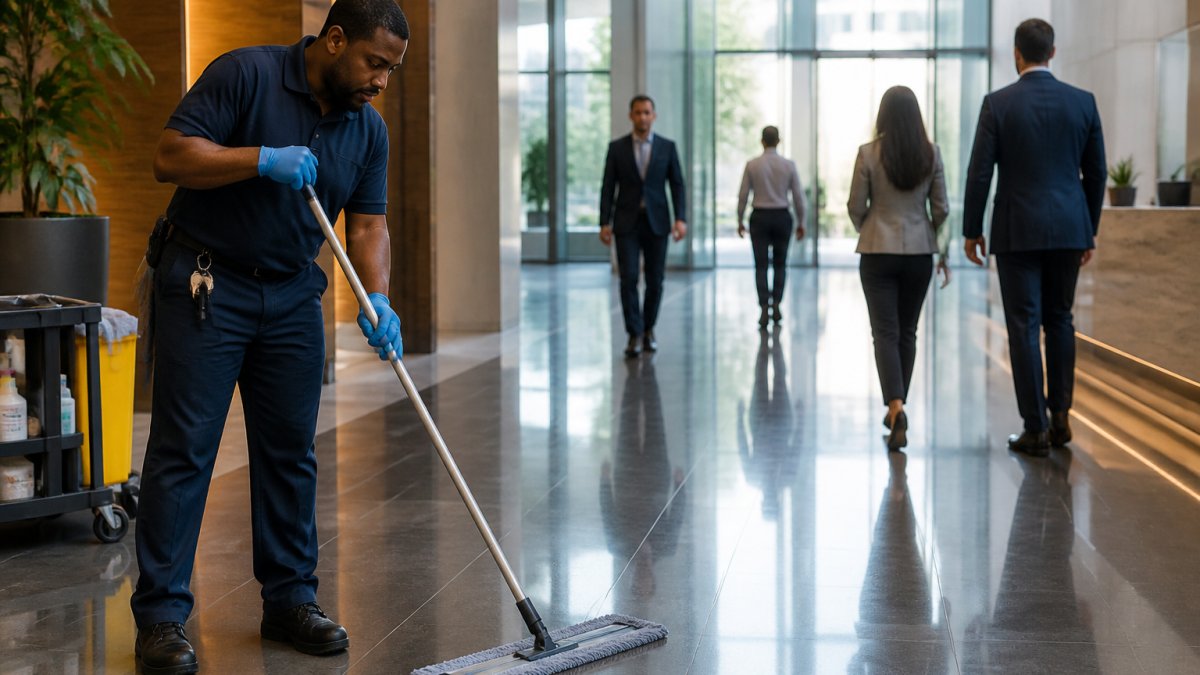
Spill response is the most critical safety function. A wet floor becomes a slip-and-fall hazard within seconds, so a professional day porter cleans and dries the area immediately, places warning signs if needed, and documents the incident.
Restroom cleanliness directly affects health and safety. Day porters disinfect surfaces, check for maintenance issues like leaking faucets or broken soap dispensers, and maintain sanitary conditions throughout the day, especially where dozens or hundreds of people share the same restrooms.
Lobby and common area maintenance prevents hazards from accumulating: debris becomes a tripping risk, overflowing trash becomes a fire hazard, and dirty surfaces harbor bacteria and viruses.
Many facility managers report that day porter services reduce tenant complaints. When people see active cleaning during the day, they perceive the property as well-maintained and professional, which directly impacts tenant satisfaction and retention.
Day Porter vs Janitor: Understanding the Difference
The terms "day porter" and "janitor" are often used interchangeably, but they describe different roles with different timing and priorities. Understanding the distinction helps you build a complete cleaning strategy.
Janitors typically work after-hours, usually evening or overnight. Their role is comprehensive deep cleaning: floor stripping and waxing, carpet shampooing, detailed bathroom scrubbing, and large-scale trash removal.
Day porters work during business hours, focusing on immediate needs and rapid response. Their role is preventive and reactive: keeping areas tidy, responding to spills, maintaining restrooms, and addressing issues as they arise. Working around occupants, they emphasize speed, minimal disruption, and high-touch surface cleaning.
Many commercial properties benefit from both. The janitorial team provides deep cleaning at night, while the day porter maintains that standard during business hours and prevents small issues from becoming big problems. This two-tier approach is common in shopping centers, office buildings, and high-traffic facilities.
The cost structure differs too. Janitorial services are typically quoted per square foot or per visit, while day porter services are often quoted hourly or per shift. Your property's size, traffic volume, and cleanliness standards determine the right combination.
Day Porter Service Checklist for Quality Control
When evaluating a day porter service or monitoring your current provider, a clear checklist ensures consistent quality and accountability. This is where many facility managers struggle: how do you verify that the service is actually meeting its obligations?
A functional day porter service checklist includes:
- Restrooms checked and cleaned every 2-3 hours
- Toilets, sinks, and dispensers in working order
- Paper products (towels, soap, toilet paper) stocked
- High-touch surfaces (door handles, faucet handles, light switches) disinfected
- Lobby and entrance swept and mopped
- Trash cans emptied before they overflow
- Spills addressed within 15 minutes of report
- Glass doors and windows cleaned of fingerprints and smudges
- Floors inspected for debris and hazards
- Restroom floors dry and safe (no slip hazards)
- Common areas free of clutter
- Any maintenance issues documented and reported
The best day porter services provide documentation, either digital logs or photos, showing when tasks were completed. This creates accountability and gives you evidence if issues arise. Many property managers report that visible documentation improves service quality because the provider knows their work is being tracked.
Response time is a key performance metric. A quality day porter responds to reported spills or issues within 15-30 minutes during business hours. If your current provider takes hours to address a safety hazard, that's a red flag indicating the service may be understaffed or poorly managed.
Consistency matters as much as initial quality. A day porter who maintains high standards Monday through Wednesday but skips tasks Thursday through Friday is unreliable. Your checklist should track performance over time, identifying patterns of inconsistency that suggest you need a different provider.
Day Porter Hiring Tips for Your Property
Hiring the right day porter service requires clear criteria and realistic expectations. Many property managers choose based purely on price, then struggle with inconsistent quality.
Start by defining your needs: which areas need the most attention, how many hours per day of coverage you need, and which tasks are non-negotiable.
Ask potential providers about their experience with properties similar to yours. A day porter service experienced with shopping centers may not understand the needs of an office building or industrial facility.
Check for clear documentation and accountability systems. A professional service provides daily logs, photos, or digital records showing when tasks were completed. If a provider resists documentation or offers only verbal assurance, that's a warning sign.
Ask about response protocols for emergencies. What happens if a pipe bursts and floods the lobby during business hours?
Request references from other property managers. Ask specifically about consistency, reliability, and whether the service has reduced maintenance complaints or liability issues.
Verify that the service carries appropriate insurance and is bonded. This protects you if an employee causes damage or someone is injured during day porter work.
Day Porter Service Checklist for Quality Control
When evaluating a day porter service or monitoring your current provider, a clear checklist ensures consistent quality and accountability. This is where many facility managers struggle: how do you verify that the service is actually meeting its obligations?
A functional day porter service checklist includes:
- Restrooms checked and cleaned every 2-3 hours
- Toilets, sinks, and dispensers in working order
- Paper products (towels, soap, toilet paper) stocked
- High-touch surfaces (door handles, faucet handles, light switches) disinfected
- Lobby and entrance swept and mopped
- Trash cans emptied before they overflow
- Spills addressed within 15 minutes of report
- Glass doors and windows cleaned of fingerprints and smudges
- Floors inspected for debris and hazards
- Restroom floors dry and safe (no slip hazards)
- Common areas free of clutter
- Any maintenance issues documented and reported
The best day porter services provide documentation, either digital logs or photos, showing when tasks were completed. This creates accountability and gives you evidence if issues arise. Many property managers report that visible documentation improves service quality because the provider knows their work is being tracked.
Response time is a key performance metric. A quality day porter responds to reported spills or issues within 15-30 minutes during business hours. If your current provider takes hours to address a safety hazard, that's a red flag indicating the service may be understaffed or poorly managed.
Consistency matters as much as initial quality. A day porter who maintains high standards Monday through Wednesday but skips tasks Thursday through Friday is unreliable. Your checklist should track performance over time, identifying patterns of inconsistency that suggest you need a different provider.
How Professional Day Porter Services Reduce Liability
Liability exposure is a serious concern for commercial property managers. Slip-and-fall incidents, inadequate restroom maintenance, and safety hazards can result in lawsuits, insurance claims, and significant financial losses. Professional day porter services directly address these risks.
Slip-and-fall prevention is the most obvious liability benefit.
Restroom maintenance prevents health code violations and disease transmission. Clean, well-maintained restrooms reduce the spread of bacteria and viruses and the likelihood of complaints to health departments (the CDC).
Regular disinfection of high-touch surfaces reduces disease transmission and demonstrates due diligence in maintaining public health. This is especially important post-pandemic, when tenants and customers expect visible sanitation efforts.
Documentation of cleaning activities provides legal protection. If someone claims injury due to negligent maintenance, records showing the area was cleaned and inspected within the past 30 minutes provide strong evidence that you maintained reasonable standards.
Professional day porter services also identify maintenance issues before they become safety hazards. A loose handrail, broken step, or water leak is spotted and reported quickly, allowing you to address it before someone is injured.
Professional day porter services transform how commercial properties maintain cleanliness and safety during business hours.
| Responsibility | Frequency | Impact |
|---|---|---|
| Restroom cleaning and disinfection | Every 2-3 hours | Prevents health code violations, disease transmission |
| Lobby and entrance maintenance | Continuous | Maintains first impressions, reduces dirt spread |
| Spill response | Within 15-30 minutes | Prevents slip-and-fall liability, maintains safety |
| Trash removal | Before overflow | Prevents fire hazards, maintains appearance |
| High-touch surface disinfection | Multiple times daily | Reduces disease transmission, shows due diligence |
| Documentation and reporting | Daily | Provides legal protection, ensures accountability |
Frequently Asked Questions
What's the difference between a day porter and a janitor?
Day porters work during business hours to maintain cleanliness and respond to immediate needs like spills and restroom upkeep while tenants and customers are present. Janitors typically perform deep cleaning and floor care after hours when the facility is closed. Day porter services focus on rapid response and ongoing maintenance, while janitorial services handle comprehensive cleaning tasks that require more time and access.
Are day porter services worth adding to a janitorial contract?
Yes, especially for high-traffic facilities like shopping centers and office buildings. Day porter services bridge the gap between after-hours janitorial work by addressing spills, restroom maintenance, and lobby appearance during peak occupancy. This prevents slip-and-fall hazards, maintains first impressions for visitors and customers, and reduces liability. Many property managers find that combining both services delivers better facility appearance and safety outcomes.
How can a day porter improve building cleanliness and safety?
Professional day porters maintain common areas, lobbies, and restrooms throughout the day, preventing dirt and grime buildup. They respond quickly to spills and hazards, reducing slip-and-fall risks. Regular surface cleaning and disinfection during business hours minimize health concerns for occupants. Consistent maintenance also creates a clean and presentable environment that improves customer experience and protects your property's reputation.
What should I look for when hiring a day porter service?
Prioritize providers with experience in your facility type (shopping centers, offices, industrial sites) and proven consistency in high-traffic areas. Ask for references from other commercial property managers and verify they offer rapid response times for spills and emergencies. Confirm they use professional-grade equipment and follow a documented service checklist. Request a customized cleaning schedule that matches your facility's traffic patterns and specific needs.