

Office Building Pressure Washing Cost: 2026 Pricing Guide
Table of Contents
- What Office Building Pressure Washing Cost Actually Covers
- Commercial Pressure Washing Cost: The Main Price Drivers
- Pressure Washing Cost Per Square Foot and Hourly Rates
- How to Read a Commercial Pressure Washing Estimate
- Building Height, Access, and Lift Requirements
- Building Pressure Washing Frequency and Recurring Contracts
- Tenant Scheduling, Water Runoff, and Compliance Costs
- Frequently Asked Questions
Last Updated: October 19, 2026
What Office Building Pressure Washing Cost Actually Covers
Office building pressure washing cost is the total a property manager pays to clean a commercial building's exterior, bundling labor, equipment, water, access, and disposal into one estimate. At Tomicic's Pressure Washing & Sweeping, we price by scope, not guesswork: a single-story retail strip is not a six-story office tower with glass, brick, and a parking structure.
Most quotes you receive will fold several line items into one number:
- Labor for a crew sized to the building's height and surface area
- Equipment including pressure units, hoses, and lifts or booms
- Water and runoff control, which matters more on commercial sites
- Surface preparation and stain treatment for oil, gum, and oxidation
What most guides miss: access, tenant scheduling, and runoff compliance frequently drive the final figure as much as wand time.
Commercial Pressure Washing Cost: The Main Price Drivers
Commercial pressure washing pricing moves with a handful of variables. The four that matter most are job size, surface material, building condition, and access.
Job Size and Surface Area
Square footage sets the baseline: more area means more wand time, more water, and often a bigger crew. But raw square footage misleads, 10,000 square feet of open concrete cleans faster per foot than the same area broken up by planters, bollards, and entryways.
Ask each contractor how they measure: do they count only cleanable hard surfaces, or the whole footprint? The answer changes the quote before any work begins.
Surface Material and Condition
Concrete, brick, siding, and glass each need different pressure and detergents. Delicate surfaces require lower pressure and more chemical dwell time, while heavily soiled surfaces with embedded oil, gum, or oxidation may need a second pass.
Condition matters as much as material. A building that has gone years without exterior cleaning costs more to bring back than one on a regular schedule.
Pressure Washing Cost Per Square Foot and Hourly Rates
Most commercial contractors quote either a price per square foot or an hourly rate.
A pressure washing cost per square foot figure should state what it includes. A low rate that excludes stain removal, gum lifting, or runoff control is an incomplete quote, not a bargain.
| Pricing Method | Best For | Watch For |
|---|---|---|
| Per square foot | Large flat surfaces, parking areas, sidewalks | Whether prep and stain treatment are included |
| Hourly rate | Small or irregular jobs, touch-ups | Missing time estimates that inflate the total |
| Fixed project price | Full-building exterior cleans | Scope gaps and change-order clauses |
| Recurring contract | Scheduled maintenance | Frequency assumptions and escalation terms |
Many property managers find that a fixed project price plus a separate recurring maintenance contract gives the clearest budget picture across a portfolio.
Office-Building-Specific Rate Ranges
Office buildings need a finer breakdown because surfaces on one property carry very different labor and equipment demands. The ranges below reflect common commercial pricing patterns; actual bids vary with region, condition, and access.
- Flat concrete sidewalks and aprons: typically the lowest per-square-foot rate because a surface cleaner covers ground quickly with minimal setup.
- Building façades (brick, stucco, EIFS, metal panel): priced higher per square foot than flatwork because crews work vertically, often from a lift, and must match pressure and detergent to the material.
- Glass and storefront entrances: usually quoted per pane, per entrance, or as a line item, since soft washing and spot-free rinse techniques differ from concrete work.
- Loading docks and service areas: priced above standard flatwork because of embedded oil, grease, and gum that require degreasers and extra dwell time.
Ask each contractor to quote these surfaces as separate lines. A blended quote hides which surface drives the price and makes fair comparison impossible.
How Contractors Build a Per-Square-Foot Number
A per-square-foot rate is not pulled from a chart. Contractors start with a production rate, how many square feet a crew cleans per hour on a given surface, then divide loaded labor and equipment cost by that rate.
When you review a bid, ask two questions: what production rate did you assume, and what crew size and equipment does it require?
Hourly Rates and Minimum Service Charges
Hourly pricing is common for small or irregular scopes, a single entrance, a dumpster pad, or touch-up work. Commercial crews carry a minimum service charge covering mobilization, setup, and a minimum block of on-site time, so the effective hourly cost is often higher than the headline rate.
Ask whether the hourly rate includes travel, water, and disposal, and confirm the minimum charge before scheduling. For a one-time small job, a fixed price is often clearer than an open-ended hourly quote.
How to Read a Commercial Pressure Washing Estimate
A commercial pressure washing estimate should read like a scope document, not a single line with a number. If you cannot tell what is being cleaned, how, and what happens to the runoff, the bid is too vague to compare.
What a Complete Quote Should Include
Use this checklist when reviewing any bid:
- Building address and the exact surfaces to be cleaned
- Cleaning method and water pressure range per surface type
- Stain and gum removal listed separately or confirmed included
- Access equipment (lift, boom, ladder) and who supplies it
Building Height, Access, and Lift Requirements
Height changes everything. Ground-level concrete can be cleaned with a standard surface cleaner, but anything above the first story requires lifts, booms, or rope access, with their own cost and scheduling constraints.
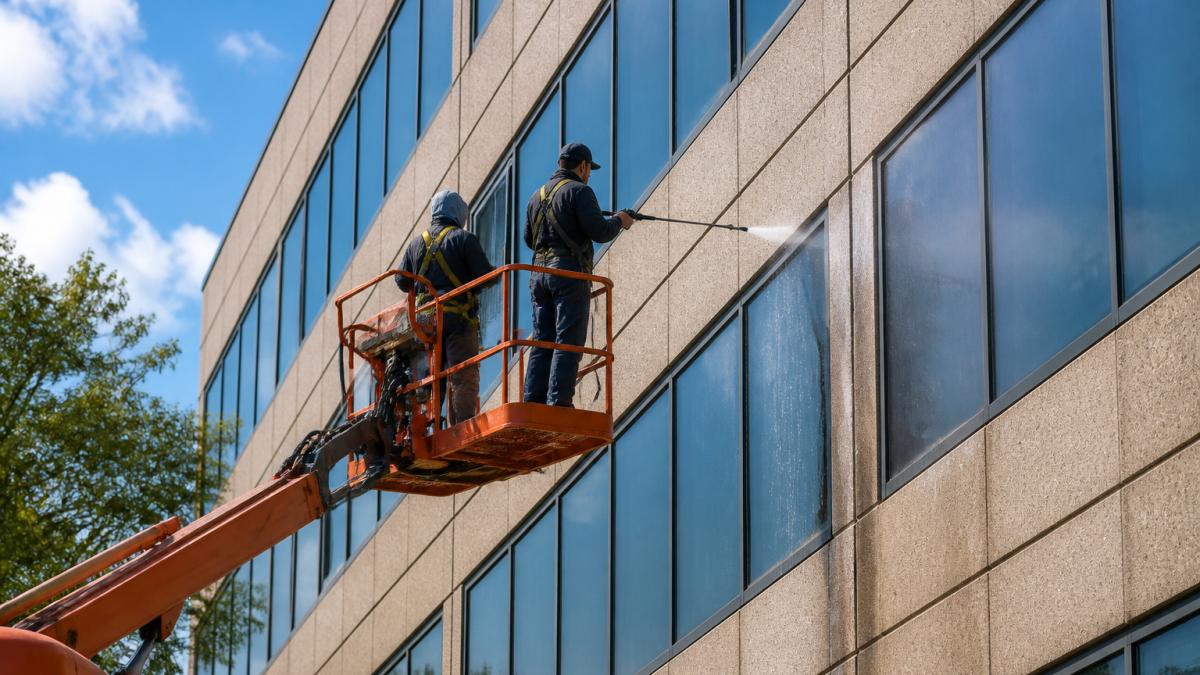
A single-story office rarely needs more than ground equipment. A mid-rise with glass and brick above the ground floor needs a lift, which needs setup space, possibly closing part of a parking area.
Ask directly: does the bid include lift rental and operator time, or is that billed separately?
How Stories Translate Into Access Methods
Most office-building bids are shaped by the access method the contractor selects. Each has a different cost profile and impact on tenant operations.
- Ground equipment only (single story, low parapets): surface cleaners, wands, and extension poles. Lowest cost, fastest scheduling, minimal disruption.
- Scissor and boom lifts (roughly two to five stories): the workhorse for mid-rise façades. The lift must be rented or owned, transported, and operated by a trained operator, and it needs a stable setup area, often a closed section of parking or a blocked lane.
- Swing stages and suspended platforms (mid- to high-rise): rigged from the roof, these reach elevations lifts cannot and avoid ground-level setup, but rigging, roof access, and safety planning add labor and time.
- Rope access (high-rise and difficult elevations): trained technicians work from ropes, which can reach complex façades and setbacks without heavy equipment on the ground. It demands certified crews and careful safety planning, and not every contractor offers it.
A contractor who quotes a mid-rise façade without naming the access method is leaving the largest variable undefined. That gap is where change orders come from.
What Access Really Adds to the Bill
Access cost is not just the rental fee. It includes mobilization, operator time, setup and teardown, safety planning, and the cost of closing parking or walkways.
Scheduling compounds it. Lifts and swing stages are often booked in advance, and roof access or parking closures need coordination with property management and tenants. A tight site may require after-hours work at a premium.
Questions to Ask Before You Compare Bids
- What access method will you use for each elevation, and is the equipment included in the price?
- Who operates the lift or rigs the stage, and what safety training and certifications do they hold?
- What parking, lane, or walkway closures will the work require, and who coordinates them with tenants?
- Does the quote account for roof access, setbacks, and any elevation that cannot be reached from the ground?
- What happens if weather or site conditions delay the work, how are access costs handled?
A bid that answers these questions is comparable to another that does. A bid that skips them is a placeholder, and the real number arrives later.
Building Pressure Washing Frequency and Recurring Contracts
Building pressure washing frequency drives your annual budget more than any single clean. A building on a regular schedule stays ahead of dirt and grime, and each visit costs less than a deep restoration clean.
Recurring contracts set frequency based on traffic and exposure: a busy office with a parking structure may need more frequent cleaning than a low-traffic professional building.
A scheduled maintenance plan keeps the façade presentable year-round and spreads cost into predictable increments instead of one large annual hit. Tomicic's Pressure Washing & Sweeping builds tailored service packages so a multi-property portfolio can align schedules with each site's traffic pattern.
Tenant Scheduling, Water Runoff, and Compliance Costs
Two costs hide in almost every commercial bid: scheduling around tenants and managing water runoff.
Office buildings run on tenant schedules. Crews often work early mornings, evenings, or weekends to avoid disruption, and off-hours scheduling can carry a premium.
Runoff is the compliance side. The EPA stormwater program guidance explains why controlling wash water matters on commercial sites, and the OSHA standards for workplace safety govern how crews manage hazards during the work.
Insurance and safety qualifications belong in this conversation too. For property managers weighing a professional service against DIY, the Small Business Administration guidance on contractor selection offers a useful framework for vetting any vendor before signing.
Commercial pressure washing cost comes down to scope, access, and scheduling, and the cheapest bid is rarely the one that protects your property.
Frequently Asked Questions
How much does it cost to pressure wash an office building?
There is no single price because office building pressure washing cost depends on square footage, surface material, building height, and how much dirt or staining has built up. A single-story building with a concrete sidewalk and small facade costs far less than a multi-story property that needs lift access. Providers usually price by square foot, by the hour, or as a fixed project quote, and most set a minimum service charge for smaller jobs. Ask for a written commercial pressure washing estimate that itemizes labor, equipment, and access so you can compare quotes fairly.
Is commercial pressure washing priced by the square foot?
Often, yes. Pressure washing cost per square foot is the most common way providers quote flatwork like sidewalks, parking areas, and driveways, because the measurement is easy to verify. Vertical surfaces such as siding, brick, and building facades are sometimes priced per square foot too, but access difficulty and surface material can push the rate up. Hourly pricing shows up more on smaller or irregular jobs, and many providers convert an hourly estimate into a fixed project price once they have walked the site.
How often should an office building be pressure washed?
Building pressure washing frequency depends on climate, foot traffic, and how visible the exterior is to tenants and visitors. Many property managers schedule exterior washing once or twice a year, with high-traffic entryways, sidewalks, and parking areas cleaned more often. Buildings near busy roads, trees, or industrial activity tend to need more frequent service. A recurring maintenance contract usually lowers the per-visit cost and keeps the schedule consistent, which matters for inspections and tenant expectations.
What should an office building pressure washing quote include?
A complete commercial pressure washing estimate should list the surfaces being cleaned, the cleaning method for each, the square footage or time on site, and whether lift access or special equipment is needed. It should also state the minimum charge, any additional services like stain removal or sidewalk cleaning, and how water runoff will be managed. Ask whether the price is fixed or hourly, what happens if the crew finds unexpected damage, and whether the provider carries insurance. Comparing quotes on these details matters more than comparing the bottom line alone.