

How to Respond to an Oil Spill in California
Last Updated: November 2, 2026
Quick Summary
Emergency oil spill cleanup services in California begin with protecting people, stopping the spread away from drains, and calling the state and federal reporting lines. The responsible party must report releases to the California State Warning Center, and cleanup follows containment, recovery, decontamination and licensed waste disposal.
- Keep people away from the area, shut off ignition sources and do not wash the oil with water or detergent.
- Report releases to the California State Warning Center and, where navigable waters are affected, the National Response Center.
- Document the time of discovery, estimated volume, location, agency calls and photos before cleanup begins.
- Capture oily wastewater and saturated absorbents rather than letting them reach a storm drain.
- Ask for itemized quotes and disposal documentation, and confirm the provider offers true 24/7 emergency dispatch.
Table of Contents
- What to Do in the First 15 Minutes After an Oil Spill
- Oil Spill Reporting Requirements in California
- Rapid Assessment and Site Safety Before Cleanup Begins
- Oil Spill Containment and Cleanup Steps
- Building a Spill Response Plan by Setting and Substance
- How the Oil Spill Cleanup Process Works, From Recovery to Disposal
- Choosing a 24/7 Emergency Cleanup Provider and What It Costs
- Frequently Asked Questions
Oil on a commercial parking lot or industrial floor can spread faster than most people expect, and when you need emergency oil spill cleanup services in California, the first decisions you make often determine how much cleanup, reporting and cost follows. This guide walks through what to do, who to notify and what to look for in a provider. Following a clear sequence keeps people safe and keeps the response on track.
What to Do in the First 15 Minutes After an Oil Spill
The first priority is keeping people out of harm's way. Stop anyone from walking through the area, shut off nearby ignition sources and move vehicles away if it is safe to do so. Do not attempt to clean up a large or unknown release yourself.
Next, identify what was spilled and how much. A small drip from a parked car is a different situation from a hydraulic line failure. Note the location, the approximate volume, whether the material has reached a storm drain or any waterway, and whether anyone has been exposed.
Watch out: pouring water or detergent onto an oil spill can spread the product into drains and surface water, which turns a contained problem into a reportable one.
Finally, call for help. Have your contact list ready before an incident happens.
Oil Spill Reporting Requirements in California
Reporting is where most commercial spills become more expensive than they needed to be, and it is the part of the response most often handled wrong. California layers state and federal obligations on top of each other, and the duty to report generally falls on the responsible party, usually the facility operator, the transporter, or the party that caused the release.
The state framework runs through the Governor's Office of Emergency Services (Cal OES), which operates the California State Warning Center as the 24-hour notification point for oil and hazardous material releases (Spill Release Reporting). In practice, a release of oil or a hazardous material that threatens people, property, or the environment must be reported to the State Warning Center as soon as the responsible party has knowledge of it. The commonly cited trigger is a release that poses a threat, but the safest operating rule for a facility is to call first and let the agency tell you whether the release is below threshold.
Federal reporting sits alongside the state duty. Federal reporting sits alongside the state duty, and releases of oil that reach navigable waters can trigger federal notification obligations to the National Response Center. A release that reaches a storm drain is a common example of a spill that starts as a state report and becomes a federal one.
Petroleum storage sites may carry additional reporting and planning obligations under state and federal programs. Check your site's spill prevention plan, if one is required, for the notification contacts it lists.
Documentation should start the moment the spill is discovered. Record the time of discovery, the material and estimated volume, the location, whether any drain or waterway was affected, the time each agency was called, the name of the person who took the report, and any incident or report number issued. Photograph the scene before cleanup begins. That timeline and photo set supports the regulatory file, the insurance claim, and any follow-up inspection.
California State Warning Center hazardous material spill reporting National Response Center reporting
Rapid Assessment and Site Safety Before Cleanup Begins
Before any cleanup starts, a qualified responder should assess the extent of the release. That means mapping the affected area, checking for drains and surface water routes, and identifying the substance so the right absorbent, containment and disposal method is chosen.
Site safety comes next. Responders should wear appropriate personal protective equipment, and anyone entering a contaminated zone should be trained for hazardous material work. Ventilation and fire risk also need attention, particularly around fuels and solvents.
Oil Spill Containment and Cleanup Steps
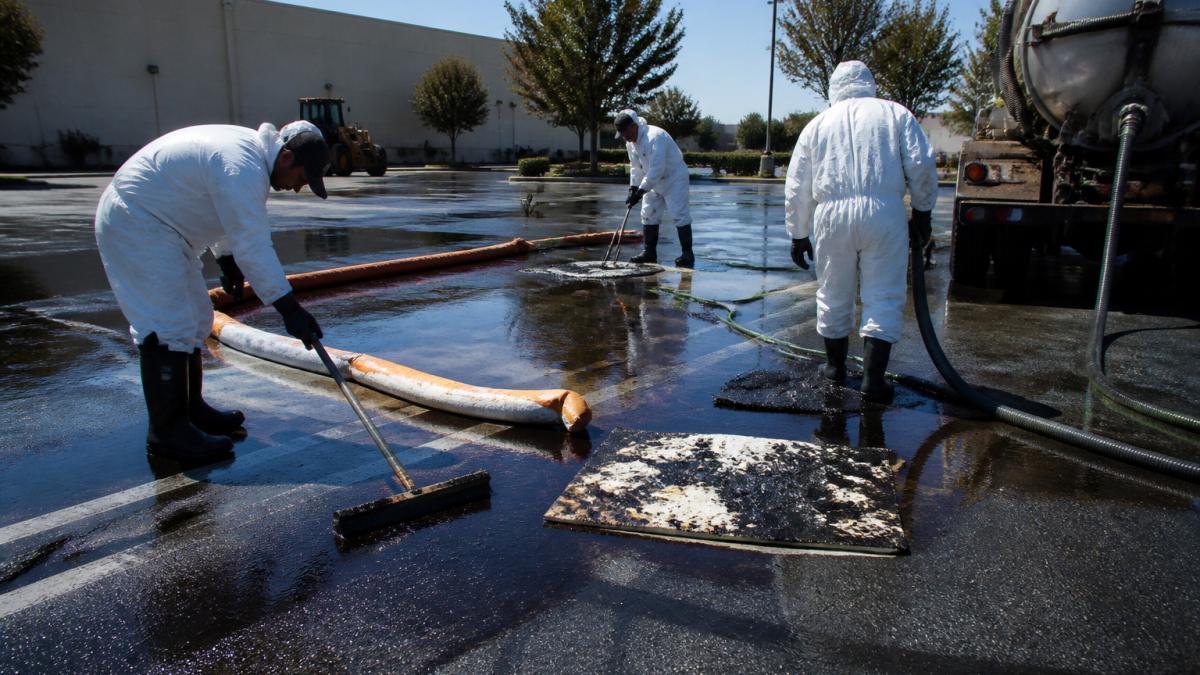
Containment comes first. Responders place absorbent booms or socks around the spill to stop it from reaching drains, and they lay absorbent pads over the surface. The goal is to hold the product in place until it can be recovered.
Once contained, the material is recovered with absorbents, vacuum equipment or pumps depending on volume. Surfaces are then cleaned to remove residual staining. Many businesses find that the staining left on concrete takes more than one pass, so plan for a follow-up visit. Follow these steps to remove graffiti and stains from concrete for guidance on the residual staining.
The core cleanup sequence, from containment to recovery, is summarised below.
Step |
What to do |
Note |
|---|---|---|
Containment |
Place absorbent booms or socks around the spill |
Stops product reaching drains |
Surface coverage |
Lay absorbent pads over the surface |
Holds product in place |
Recovery |
Remove product with absorbents, vacuum or pumps |
Depends on volume |
Surface cleaning |
Clean residual staining from surfaces |
May need a follow-up visit |
Building a Spill Response Plan by Setting and Substance
A useful spill response plan is specific to where the facility operates and what it stores or handles. A loading dock, a fleet yard and a shopping center parking structure each carry different risks and need different equipment on hand.
Write the plan around the materials on site. List the substances, where they are stored, the likely release points and the people responsible for each step. Keep the contact list, the notification steps and the location of absorbents current, and review the plan after any incident or change in operations.
How the Oil Spill Cleanup Process Works, From Recovery to Disposal
A qualified response follows a sequence, and each step produces a record that the next step depends on. Understanding the sequence helps a facility manager know what a crew should be doing and what documentation to expect at the end.
1. Assessment and characterization. The responder maps the affected area, identifies the product, estimates volume, and checks for drains, cracks, and surface-water routes. On concrete, the assessment also looks at how far the oil has penetrated the slab and whether it has reached soil beneath a joint or expansion gap. Product identification matters because a petroleum distillate, a hydraulic fluid, and a cooking oil behave differently on absorbents and generate different waste streams.
2. Containment and stabilization. Absorbent booms, socks, and pads are placed to stop the spread, and drain covers or berms protect storm inlets. On water, containment usually means boom deployment and skimming; on land, it means blocking the path to drains and surface water. The goal is to hold the product in place until it can be recovered, not to wash it away.
3. Recovery. Free product is recovered with absorbents, vacuum trucks, or pumps depending on volume and access. For a small parking-lot spill, absorbent pads and a shop vac may be enough; for a hydraulic line failure in a fleet yard, a vacuum truck is typically the right tool. Recovered liquids go into labeled containers, and saturated absorbents go into lined drums or bags.
4. Surface decontamination. After bulk recovery, residual staining is treated. The wastewater must be captured and disposed of as oily water rather than allowed to run to a storm drain. A cleanup that washes without capturing the runoff has simply moved the spill.
5. Verification. Before the site is released, confirm that no free product remains and that surfaces are clean to the agreed standard. Ask for documentation of the end condition if your site is regulated.
6. Waste handling, transport, and disposal. Oil-contaminated absorbents, recovered liquids, and oily wastewater generally cannot go into the regular trash or sanitary sewer. They move through a licensed waste hauler to a permitted treatment, storage, and disposal facility, and the shipment is documented on a manifest or non-hazardous waste record. Keep those records, they are the evidence that the material left the site lawfully, and they are commonly requested by insurers and regulators.
Choosing a 24/7 Emergency Cleanup Provider and What It Costs
When you evaluate a provider, confirm that they offer true 24/7 emergency dispatch, not just extended business hours. Learn how to book same-day emergency cleanup service if you need a crew on site quickly. Ask how quickly a crew can reach your site, what equipment they bring and whether they handle waste disposal and reporting support in addition to physical cleanup.
Pricing depends on the size of the spill, the substance involved, the surface affected, the time of day and the disposal required, so there is no single standard figure. See how commercial street sweeping costs are priced for surface cleaning after recovery. Request a written quote that itemizes response, cleanup, containment and disposal, and ask about insurance coverage. Commercial property owners should also check whether their policy covers spill response before an incident occurs.
Tomicic's Pressure Washing & Sweeping provides 24/7 emergency call-outs for commercial and industrial properties, and same-day service is available for emergency sweeping. For current rates or a quote tailored to your site, contact the team directly and request a free estimate.
Frequently Asked Questions
What should you do immediately after an oil spill?
Stop the source if it is safe to do so, keep people away from the area, and shut off ignition sources nearby. Do not hose the oil into storm drains, because drains in California typically flow untreated to local waterways. Limit foot and vehicle traffic, put up barriers or cones, and call for emergency response. Document the spill with photos and notes on location, time, and approximate volume, since those details are needed for reporting and insurance claims.
When does an oil spill need to be reported?
Reporting depends on the amount released and whether it reached water or a storm drain. Spills that reach surface waters or storm drains generally must be reported right away to the California Office of Emergency Services and the National Response Center, and federal rules apply to discharges that reach navigable waters. Facilities should review their own permits and spill plans, because some require notice within a set number of hours. When in doubt, report, since late reporting can lead to larger penalties.
Who should you call for emergency oil spill cleanup?
Call a licensed hazardous materials cleanup contractor that offers 24/7 dispatch and can respond the same day. Confirm the provider can handle both land and water spills, has spill response equipment on hand, and manages oily waste for proper disposal. Ask for references from commercial or industrial clients, verify insurance and licensing, and request a written scope of work before the crew mobilizes. Contact Tomicic's Pressure Washing & Sweeping for current availability and a free estimate.
Can employees clean up an oil spill themselves?
Small spills may be handled by trained employees with the right personal protective equipment and absorbent materials, but larger releases, spills involving hazardous substances, or spills near waterways should be left to trained responders. Workers who clean up spills need to follow hazard communication and worker safety rules. Untrained cleanup can spread contamination and create exposure risks, so when the source, volume, or substance is unclear, call professionals.
