

7 Steps to Soft Washing Commercial Building Exteriors
Last Updated: November 8, 2026
Quick Summary
Soft washing for commercial building exteriors cleans structures with low water pressure and specialized biodegradable cleaning solutions instead of brute force. The solution kills algae, mold, mildew, and bacteria at the root, then rinses away gently, protecting painted façades, brick, vinyl siding, awnings, and signage from damage.
- High pressure can etch concrete, pit brick, tear paint, and force water under siding.
- Inspect and photograph existing damage before any chemical touches the wall.
- Apply the solution from the bottom up and rinse from the top down under low pressure.
- Reapply a correct dilution for heavy growth rather than doubling the strength.
- Schedule twice a year for shaded or humid sites and once a year for most office and retail exteriors.
Table of Contents
- Why Soft Washing Beats Pressure Washing on Commercial Building Exteriors
- Soft Washing vs. Pressure Washing: What Property Managers Need to Know
-
A 7-Step Commercial Soft Washing Workflow From Inspection to Final Rinse
- Step 1: Inspect and Document Surface Conditions
- Step 2: Select Chemicals and Dilution for Each Building Material
- Step 3: Prepare the Site, Protect Landscaping, and Control Access
- Step 4: Apply the Solution From the Bottom Up
- Step 5: Respect Dwell Time and Reapply Where Growth Is Heavy
- Step 6: Rinse From the Top Down Under Low Pressure
- Step 7: Perform Final Inspection, Documentation, and Acceptance Checks
- Soft Washing Safety Precautions for Workers, Occupants, and Landscaping
- Commercial Building Washing Frequency: How Often to Schedule Service
- Your Commercial Exterior Cleaning Checklist Before, During, and After Service
- Request a Free Estimate From Tomicic's Pressure Washing & Sweeping
- Frequently Asked Questions
Why Soft Washing Beats Pressure Washing on Commercial Building Exteriors
Soft washing for commercial building exteriors is the practice of cleaning a structure with low water pressure and specialized cleaning solutions instead of brute force. High-pressure blasting can damage building faces more than it cleans them. The method matters more than the muscle.
Commercial exteriors face dirt, grime, algae, mold, mildew, and bacteria all year. High pressure strips the surface and drives water behind siding. Soft washing uses biodegradable chemicals to treat growth, then rinses it away gently.
That protects painted façades, architectural brick, vinyl siding, awnings, signage, and other delicate surfaces high pressure would scar, improving curb appeal without risking damage. For property managers, one service solves appearance and surface protection at once.
Below: the exact seven-step workflow, safety precautions, and cleaning frequency that keeps a commercial property in shape.
Soft Washing vs. Pressure Washing: What Property Managers Need to Know
The difference comes down to water pressure and chemistry. Soft washing relies on low-pressure cleaning and a cleaning solution. Pressure washing relies on high water pressure.
On a commercial building, high pressure can etch concrete, pit brick, tear paint from a painted façade, force water under vinyl siding, and get behind signage. Soft washing treats the surface like something worth protecting.
| Factor | Soft Washing | Pressure Washing |
|---|---|---|
| Water pressure | Low, surface-safe | High, forceful |
| How it cleans | Cleaning solution + dwell time | Mechanical force |
| Best for | Painted façades, siding, awnings, signage | Concrete, parking areas, hard flatwork |
| Risk to delicate surfaces | Minimal | High |
| Biological growth | Killed at the root | Blasted, often returns |
| Typical use | Building exteriors, walls | Ground-level hard surfaces |
A common mistake is assuming one method fits every surface. In practice, the best commercial exterior services use both. Soft washing handles the walls and anything fragile. Pressure washing handles the concrete and parking areas. For property managers weighing methods, our commercial pressure washing services show how the two fit together across a full site.
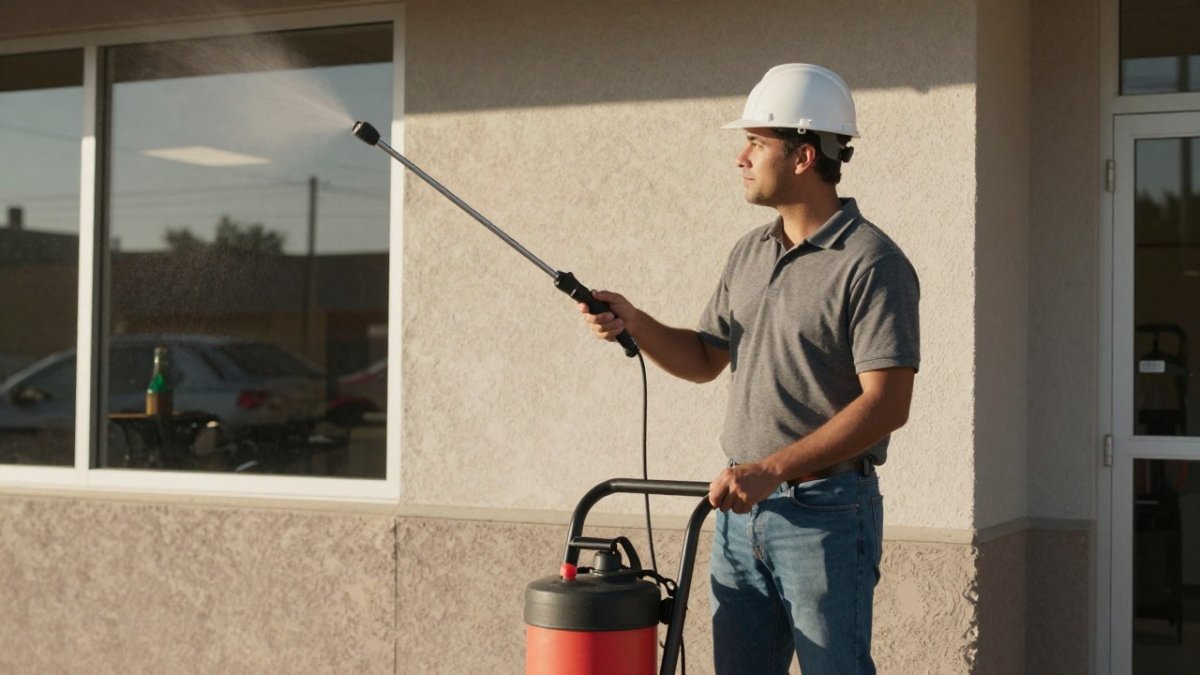
A 7-Step Commercial Soft Washing Workflow From Inspection to Final Rinse
A reliable soft wash follows a set sequence. Skip a step and you either damage a surface or leave the growth half-killed. Here is the seven-step workflow we follow on commercial properties.
Step 1: Inspect and Document Surface Conditions
Start by walking the building and recording every material. Note the painted façade, architectural brick, vinyl siding, awnings, signage, and the commercial roof. Photograph existing damage before any chemical touches the wall.
This baseline protects both sides. It shows what was already there and sets the before-and-after record. Mark any cracked caulk, loose paint, or failing sealant. Those spots need a gentler touch or a skip.
A practical inspection checklist covers substrate type (masonry, EIFS, metal panel, wood, vinyl), coating condition (chalky, peeling, intact), biological growth type and coverage percentage, oxidation or efflorescence, sealant and flashing integrity, and proximity to HVAC intakes, electrical fixtures, and landscaping. Note any failing surface: soft washing will not fix a failing coating and can accelerate its breakdown.
Step 2: Select Chemicals and Dilution for Each Building Material
Match the cleaning solution to the material, not the other way around. A mix safe on concrete can dull anodized signage or streak dark brick. Use biodegradable chemicals and adjust dilution for how porous the surface is.
Step 3: Prepare the Site, Protect Landscaping, and Control Access
Post signage and cone off wet walkways. On occupied properties, coordinate with the property manager on tenant notifications and business-hour scheduling so entrances stay usable. Confirm water access and hose runs before the crew starts, because a mid-job water shortage leaves chemical dwelling too long on the surface.
Step 4: Apply the Solution From the Bottom Up
Use low pressure only. Soft washing relies on the chemical and dwell time, not force. Keep the wand moving so no area is soaked unevenly, and watch the edges of the spray pattern so overspray does not reach cars, windows, or neighboring surfaces.
Step 5: Respect Dwell Time and Reapply Where Growth Is Heavy
Heavy biological growth may need a second application rather than a stronger mix. Reapplying a correct dilution is safer than doubling the strength. Check the surface as you go: when growth has released and the color has lifted, the dwell is done.
Step 6: Rinse From the Top Down Under Low Pressure
Rinse nearby landscaping again after the final rinse to wash away overspray or runoff, and check walkways and parking areas so chemical residue does not remain where people walk or cars park.
Step 7: Perform Final Inspection, Documentation, and Acceptance Checks
Agree acceptance criteria before the job starts: no visible biological growth, no chemical residue or streaking, no damage to coatings or sealants, and landscaping left undamaged. Log the date and conditions for the next scheduled wash so the maintenance interval is based on evidence, not guesswork.
Soft Washing Safety Precautions for Workers, Occupants, and Landscaping
Safety is where cheap soft washing jobs fall apart. Chemicals that kill mold will also irritate skin, eyes, and lungs if handled carelessly. Plan for three groups: workers, occupants, and the landscape around the building, and treat runoff as a fourth concern because it carries the chemistry wherever it flows.
Worker protection. Workers should follow the safety data sheet and label requirements for every chemical they handle. The OSHA guidance on chemical hazard communication sets the baseline for labeling and training.
Commercial Building Washing Frequency: How Often to Schedule Service
The right washing frequency for a commercial exterior depends on climate, tree cover, and foot traffic.
Buildings near trees or in humid conditions grow algae and mildew faster. High-traffic shopping centers show dirt and grime sooner. A simple schedule:
- Twice a year: shaded or humid sites, heavy algae growth
- Once a year: most office and retail exteriors
- Quarterly touch-ups: high-visibility entrances and signage
Planning a recurring schedule starts with understanding the cost drivers. Our breakdown of commercial pressure washing pricing factors explains what shapes a commercial washing budget so you can plan ahead.
Your Commercial Exterior Cleaning Checklist Before, During, and After Service
A checklist keeps a soft wash job consistent from the first site to the tenth. Use this one on every commercial property.
Before service:
- Walk the building and photograph existing damage
- Identify every material: brick, siding, awnings, signage, roof
- Confirm chemical dilution for each surface
- Notify occupants and post signage
- Pre-wet nearby landscaping
During service:
- Apply bottom-up, dwell, rinse top-down under low pressure
- Keep the wand moving to avoid residue streaks
- Check runoff clarity before moving on
- Cone off wet walkways
After service:
- Rinse landscaping and check for runoff damage
- Photograph before-and-after results
- Note any surface that needs a follow-up
- Log the date for the next scheduled wash
For a deeper, property-specific version, our dedicated guide covers what a commercial exterior cleaning checklist should include, section by section.
Request a Free Estimate From Tomicic's Pressure Washing & Sweeping
Soft washing is designed to clean exterior surfaces with low pressure, which can help protect the surfaces you maintain while removing algae, mold, and grime that affect curb appeal.
Tomicic's Pressure Washing & Sweeping was incorporated in California in 2006. We offer same-day service for construction and emergency sweeping, 24/7 emergency call outs for commercial and industrial properties, and tailored packages built around your budget. Our crews use clean, well-maintained equipment.
If soft washing is the right call for your building, our professional soft washing services cover homes, stucco, siding, and exterior walls. Ready to price your project? Request a free estimate and we'll put together a plan for your property.
Your building's exterior takes a beating from weather, growth, and traffic every season. The right cleaning schedule protects the surface and the investment behind it. Get started with Tomicic's Pressure Washing & Sweeping and keep your commercial property clean, safe, and inspection-ready.
Frequently Asked Questions
What is soft washing for commercial buildings?
Soft washing is a low-pressure exterior cleaning method that relies on specialized cleaning solutions to break down dirt, algae, mold, mildew, and bacteria before a gentle rinse washes it away. Instead of blasting surfaces with high water pressure, soft washing uses low water pressure combined with biodegradable chemicals.
How often should a commercial building be soft washed?
Commercial building washing frequency depends on your environment, including traffic, tree cover, and moisture. Property managers can adjust the interval based on visible biological growth, dirt accumulation, and upcoming city inspections. Consistent scheduling also protects curb appeal and prevents contaminants from degrading building materials over time.
Is soft washing safe for painted siding, stucco, and masonry?
Soft washing uses low water pressure and biodegradable cleaning solutions, which is why it is commonly chosen for delicate exterior surfaces that high pressure can damage.
How can a business choose a commercial soft washing provider?
Ask a provider how they handle chemical selection, occupant safety, and scheduling around business hours, and request references from other commercial property managers. Providers that offer tailored packages and same-day emergency service can be a good fit for busy properties.
